
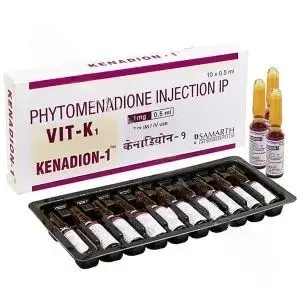
Kenadion Injection 0.5ml (Phytomenadione)
Previous product
Lioresal 10mg (Baclofen)
$17.00 $35.00Price range: $17.00 through $35.00
Next product

Rejunuron 1000mcg Injection (Methylcobalamin)
$17.50 $66.25Price range: $17.50 through $66.25
$16.00 $34.00Price range: $16.00 through $34.00
In Stock
In Stock
Kenadion Injection 0.5ml (Phytomenadione)
| Pack Size | Price | Quantity | Add To Cart | |
|---|---|---|---|---|
| 10 Injection/s | $16.00 | |||
| 20 Injection/s | $24.00 | |||
| 30 Injection/s | $34.00 | |||
| Want to order in bulk / B2B price? Send Inquiry | ||||
×
Sorry!! Out of Stock
Sorry! Kenadion Injection 0.5ml (Phytomenadione) is out of stock
Please click below to view other similar medications.
View All Phytomenadione Products
Offer You Can't Resist
Free Shipping
Enjoy Free Shipping on Orders above AUD304 (USD199)
Estimate Shipping :
07 June - 14 June
25
Customer service
Customer service was responsive and medicines arrived in perfect condition
 Australia
May 19, 2026
Last Updated on April 18, 2026

Description
Kenadion Injection 0.5ml (Phytomenadione): Essential Vitamin K for Blood Clotting
Clotting of blood is an important process to prevent excessive bleeding after we are injured. One of the major factors involved in the method is vitamin K, a fat-soluble vitamin that is essential to the production of specific clotting agents within the liver. Kenadion Injection 0.5ml, containing Phytomenadione (Vitamin K1), is a frequently used drug to prevent and treat bleeding disorders that are caused due to vitamin K deficiency.
This blog post explains the essential information you should learn about Kenadion injection, the importance of it, how to use it dose, as well as safety aspects.
What is Kenadion Injection 0.5ml?
Kenadion Injection has Phytomenadione, which is the synthetic variant of Vitamin K1, which is a crucial vitamin that aids the body in creating clotting factors II, VII, and IX. The clotting factors comprise proteins that are used to make blood clots to stop blood loss.
The injectable version of vitamin K can be used for quick treatment of vitamin K deficiencies is needed or the oral administration of vitamin K is not practical.
How Does Kenadion (Phytomenadione) Work?
Vitamin K serves as a cofactor in the production of an enzyme known as Gamma-glutamyl Carboxylase, located in the liver. This enzyme can modify certain factors that cause clotting, and allow the clotting factors to bind calcium ions. This is essential for their biochemical function in the clotting cascade.
If vitamin K levels are deficient or inhibited, factors that cause clotting are released as inactive forms, resulting in a decrease in blood clotting and an increased chance.
Kenadion injections replenish the vitamin K reserves promptly, enabling liver cells to make active factors for clotting and return normal blood coagulation.
Uses of Kenadion Injection
Kenadion Injections are prescribed for different clinical scenarios, such as:
- Treatment and prevention of vitamin K deficiency bleeding (VKDB): Particularly in infants, when the vitamin K stores are depleted.
- Reversal of anticoagulant overdose: For example, warfarin or vitamin K antagonists should be used when the urgent treatment of blood-clotting problems is required.
- Management of bleeding caused by liver disease: The liver might be in a position to not activate the clotting factors in a proper manner.
- Before surgery or invasive procedures: For patients who have a vitamin K deficiency, this can help reduce the risk of bleeding.
- Certain malabsorption conditions: In cases where the absorption of vitamin K in the mouth decreases (e.g., cystic fibrosis and celiac diseases).
Dosage and Administration
- The dosage of Kenadion Injection will depend on the patient’s condition, age, and the severity of the deficiency.
- The most common method of administration is subcutaneously (IM) or subcutaneously (SC). In the event of an emergency, intravenous (IV) administration is possible under medical surveillance.
- A single dose of 0.5 or 1 mg is usually taken shortly after the birth.
- In adults, the dose varies depending on the indication between 1 and 10 mg.
- Follow your doctor’s directions regarding dosage and method.
Benefits of Kenadion Injection
- Rapid Correction: Rapidly replenishes the levels of vitamin K for effective production of clotting factors.
- Prevents Serious Bleeding: In particular, in babies and patients with blood thinners.
- Safe and Effective: If used in accordance with the instructions of medical professionals.
- Essential in Emergency Care: Essential for reversing bleeding that could be life-threatening.
Possible Side Effects
Kenadion Injections are generally well tolerated. However, side reactions may be experienced:
- Injection site reactions: Pain, swelling, or redness.
- Allergic reactions: Rash, itching, or rarely anaphylaxis.
- Flushing or dizziness: Infrequently, following rapid IV administration.
- Hemolytic anemia: Rare, particularly for patients suffering from certain genetic diseases.
Take immediate medical care if you notice serious allergic symptoms such as trouble breathing or swelling of your throat and face.
Precautions and Warnings
- Consult your physician if you are allergic to vitamin K or other ingredient.
- Be cautious in patients suffering from liver diseases or disorders of coagulation.
- IV injections should be administered gradually to prevent negative reactions.
- It is not a replacement for urgent medical attention in cases of severe bleeding under the supervision of a doctor.
- Be sure to keep away from young children.
Storage Instructions
- Keep the Kenadion injector in a dry and cool space far from bright sunlight.
- Seal the container until you need it.
- Use only until the date of expiry.
Frequently Asked Questions (FAQs)
Q: Can Kenadion Injection be used in newborns?
Yes, it is given to babies shortly after birth to help prevent bleeding due to vitamin K deficiencies.
Q: How quickly does Kenadion work?
The effects typically start within just a couple of hours, and the complete correction of factors that cause clotting takes place in less than 24 hours.
Q: Is Kenadion safe during pregnancy?
Yes, Vitamin K is vital and usually secure when it is administered under medical supervision during pregnancy.
Q: Can Kenadion reverse all types of bleeding?
This treatment specifically addresses the bleeding caused by vitamin K deficiency, or excessive doses of anticoagulants, but doesn’t solve all causes of bleeding.
Conclusion
Kenadion Injection 0.5ml (Phytomenadione) can be essential in the treatment and prevention of bleeding disorders that are caused by the deficiency of vitamin K. When used in the care of newborns as a way to reverse anticoagulant effects or to treat bleeding associated with liver diseases, Kenadion plays an essential function in maintaining proper blood clotting.
Make sure to use Kenadion under the direction of a qualified healthcare professional in order for safety and efficacy. If you’re concerned about bleeding risk or a deficiency in vitamin K, talk to your doctor about proper testing and treatments.
Disclaimer: This blog is meant for informational purposes only. It is not meant to substitute for expert medical guidance. Always consult with your doctor prior to attempting or stopping any medicine.
Related products


Recently Viewed
Reviews
There are no reviews yet.