
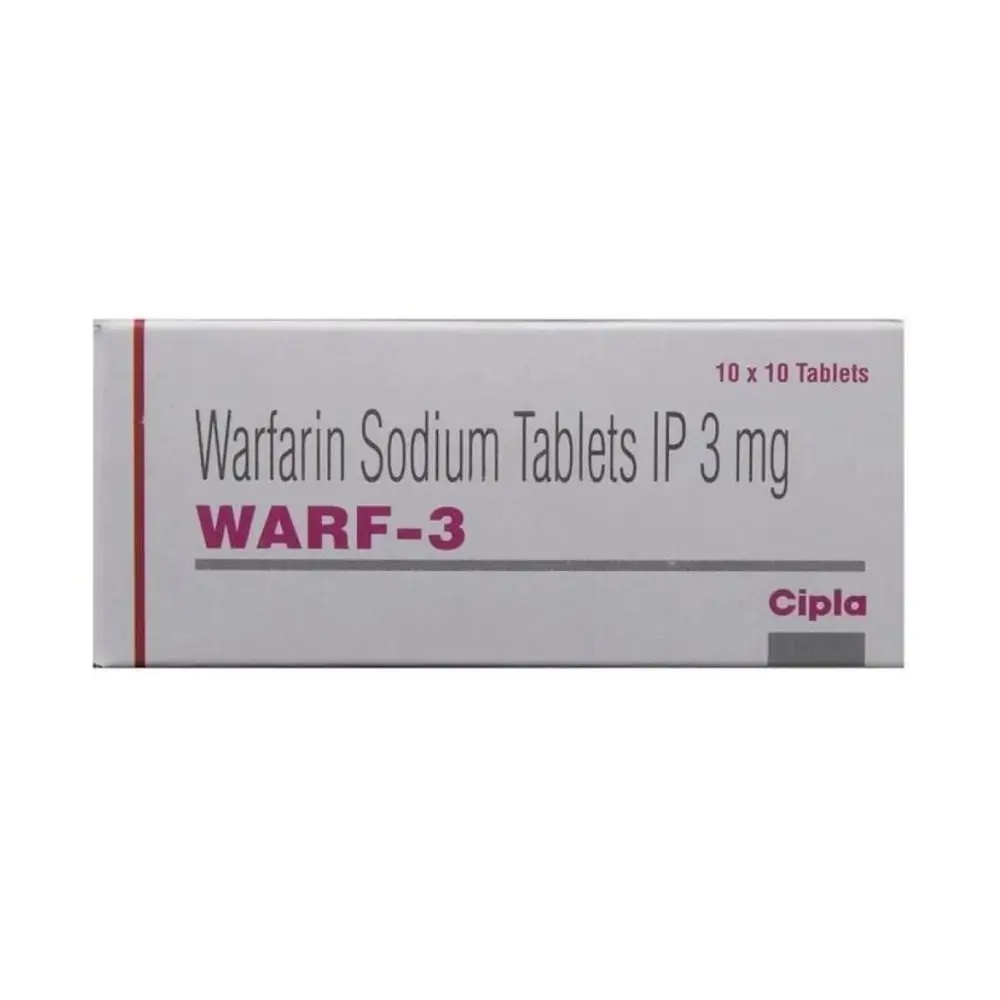
Warf 3mg (Warfarin)
Previous product
Warf 5mg (Warfarin)
A$3.42 A$8.64Price range: A$3.42 through A$8.64
Next product

Coversyl 4mg (Perindopril)
A$33.00 A$72.50Price range: A$33.00 through A$72.50
A$21.50 A$41.80Price range: A$21.50 through A$41.80
In Stock
In Stock
Warf 3mg (Warfarin)
| Pack Size | Price | Quantity | Add To Cart | |
|---|---|---|---|---|
| 60 Tablet/s | A$21.50 | |||
| 90 Tablet/s | A$31.60 | |||
| 120 Tablet/s | A$41.80 | |||
| Want to order in bulk / B2B price? Send Inquiry | ||||
×
Sorry!! Out of Stock
Sorry! Warf 3mg (Warfarin) is out of stock
Please click below to view other similar medications.
View All Warfarin Products

Offer You Can't Resist
Free Shipping
Enjoy Free Shipping on Orders above AUD304 (USD199)
Estimate Shipping :
21 July - 28 July
26
Last Updated on June 29, 2026

Description
Introduction
Warf 3mg is an anticoagulant oral medicine that contains Warfarin Sodium, an antagonist of vitamin K. It’s utilized for the purpose of helping combat and treat thromboembolic conditions by reducing the development of blood clots that cause harm. Warfarin has been the cornerstone of anticoagulant therapy for a long time, with a demonstrated experience in the treatment of stroke, deep vein thrombosis (DVT), pulmonary embolism (PE), and various bleeding occasions.
Warf 3mg has been manufactured to be in compliance with high-end standards that ensure consistency in performance and security during long-term anticoagulation treatment.
Composition
Each tablet of Warf 3mg contains:
- Warfarin Sodium – 3 mg
Excipients are lactose, magnesium stearate, starch, and colorants.
Pharmacological Class
- Therapeutic Class: Oral Anticoagulant
- Pharmacological Class: Vitamin K Antagonist
- ATC Code: B01AA03
Mechanism of Action
Warfarin is a drug that inhibits its vitamin K epoxide reductase complex (VKORC1), an important enzyme in the activation of vitamin K-dependent clotting factors II, VII, IX, and X, in addition to those anticoagulant proteins C and S.
Through depleting Vitamin K active reserves, Warfarin causes a decrease in the synthesis of functional clotting factors, which results in slowing down the coagulation process as well as preventing the formation of clots.
Indications
Warf 3mg can be used to be used for the prevention and treatment of thromboembolic conditions under the following conditions:
Treatment:
- Deep vein thrombosis (DVT)
- Pulmonary embolism (PE)
Prevention:
- Thromboembolic events in atrial fibrillation (AF)
- Stroke in patients with non-valvular AF
- Systemic embolism post-myocardial infarction
- Recurrence of DVT or PE
- Prosthetic heart valves (mechanical or biological)
Dosage and Administration
Initial Dosage:
- Based on specific patient aspects like age and weight, INR, the liver’s function, diet, and drug interactions.
- Common starting dose: 2–5 mg once daily for the first 1–2 days.
Maintenance Dose:
- Typically, 2-10 mg per day adjusted to the International Normalized Ratio (INR).
- The recommended INR range is typically 2.0 to 3.0, or 2.5 to 3.5 in patients with high risk (e.g., electronic heart valves).
Route of Administration:
- Oral, and ideally in the same order each throughout the day.
Monitoring:
- INR monitoring is crucial to ensure the safety and effectiveness of treatment.
- Monitoring is more frequent for initiation, dosage adjustment, or any changes to other medications or diets.
Contraindications
Warf 3 mg is not recommended when the following conditions are present:
- Hypersensitivity to Warfarin or any excipient
- Active bleeding or high risk of bleeding
- Recent or planned surgery with a high risk of bleeding (e.g., eye, spinal, brain surgery)
- Severe hepatic impairment
- Pregnancy (Category X) – Warfarin is teratogenic
- Uncontrolled hypertension
- Hemorrhagic stroke or cerebral aneurysm
- History of warfarin-induced skin necrosis
Precautions and Warnings
- Narrow therapeutic window – The regular INR monitoring is a must
- Be cautious when treating patients who suffer from:
- Liver or kidney dysfunction
- History of gastrointestinal bleeding
- High fall risk or poor compliance
- Interactions between various medications and food components
- Beware of elderly patients as well as people with dementia or mental disorders
- Effective contraception is recommended for pregnant women
Drug Interactions
Warfarin contains numerous drug-drug and food-drug interactions, which could increase the effectiveness of its anticoagulant.
Potentiates Warfarin Effect (↑ INR):
- Antibiotics (e.g., metronidazole, erythromycin)
- Antifungals (fluconazole, ketoconazole)
- Amiodarone
- NSAIDs
- SSRIs and SNRIs
- Alcohol (acute use)
Reduces Warfarin Effect (↓ INR):
- Rifampin
- Carbamazepine
- Barbiturates
- Vitamin K supplements
- Green leafy vegetables (spinach, kale, broccoli – high in vitamin K)
Note: Inform your doctor about any medications, which include over-the-counter medications as well as herbal supplements.
Adverse Effects
Common:
- Minor bleeding (gums, nosebleeds, easy bruising)
- Nausea or abdominal discomfort
Serious:
- Major bleeding (gastrointestinal, intracranial, retroperitoneal)
- Hemorrhagic stroke
- Warfarin-induced skin necrosis
- Purple toe syndrome
- Allergic reactions (rash, pruritus)
Overdose and Management
Symptoms of overdose can include excessive bleeding or bleeding for a long time, hematuria, or black stools. It can also cause an intense headache.
Management:
- Do not take Warfarin if INR is high, but there’s no bleeding
- Take Vitamin K either orally or intravenously if you have bleeding issues.
- Utilize fresh frozen plasma (FFP) or prothrombin complex concentrate (PCC) in cases of hemorrhage that is life-threatening hemorrhage.
- The need for hospitalization could be necessary to reverse the situation and monitor it
Use in Special Populations
Pregnancy:
- Contraindicated – Warfarin is a drug that crosses the placenta. It can cause bleeding in the fetus as well as congenital malformations and miscarriage.
Lactation:
- Warfarin is considered to be safe while breastfeeding.
Pediatrics:
- Only use under the supervision of a specialist using a dose adjustment and strict INR surveillance.
Elderly:
- Sensitivity increases; fewer doses at first are typically required.
Clinical Benefits
- Proven Efficacy: Years of experience in clinical practice, as well as research into preventing and treating arterial venous thrombosis
- Adjustable Dosage: Dosing that is tailored allows for the precise control of the anticoagulation process
- Cost-effective: Warfarin continues to be one of the cheapest oral anticoagulants. It is particularly important when it comes to long-term care
Limitations
- Needs constant INR monitoring
- Interactions between drugs and food are a must for a careful and controlled lifestyle
- The onset is slower, and offsets are less severe in comparison to direct oral anticoagulants (DOACs)
Even with these drawbacks, the Warf 3mg dose remains an important medication for conditions in which DOACs aren’t appropriate or not recommended, for example, for the case of mechanical valves for the heart.
Patient Counseling Points
- INR Monitoring: Stress the importance of periodic blood tests that check the INR.
- Dietary Consistency: Make sure you are eating a regular amount of high vitamin K foods, and beware of drastic changes in your diet.
- Bleeding Risks: Be aware of the signs for bleeding (e.g., bleeding from dark stool or excessive bleeding) and when you should get help.
- Medication Adherence: Do not take Warf more than once every morning. Do not double-dose if missed.
- Interactions: Be sure to inform all healthcare professionals (dentists and pharmacists) regarding Warfarin usage before any procedure or treatment.
- Pregnancy Warning: Utilize a reliable contraceptive during treatment. Inform your healthcare professional immediately if you suspect pregnancy.
Storage and Packaging
- Place the items in a dry, cool place and away from the light and moisture.
- Make sure that the area is safe for young children.
- In blister packs comprising 10 tablets.
Conclusion
Warf 3mg (Warfarin) is a well-tested oral anticoagulant, which is essential in the treatment of thromboembolic diseases. Despite the necessity for constant control and lifestyle changes Warf 3mg provides a safe, economical, and reliable method of preventing severe bleeding due to clots. Warf 3mg remains an effective primary treatment in certain clinical situations, like mechanical heart valves, as well as certain kinds of atrial fibrillation in which other treatments are not suitable.
Related products

Reviews
There are no reviews yet.