
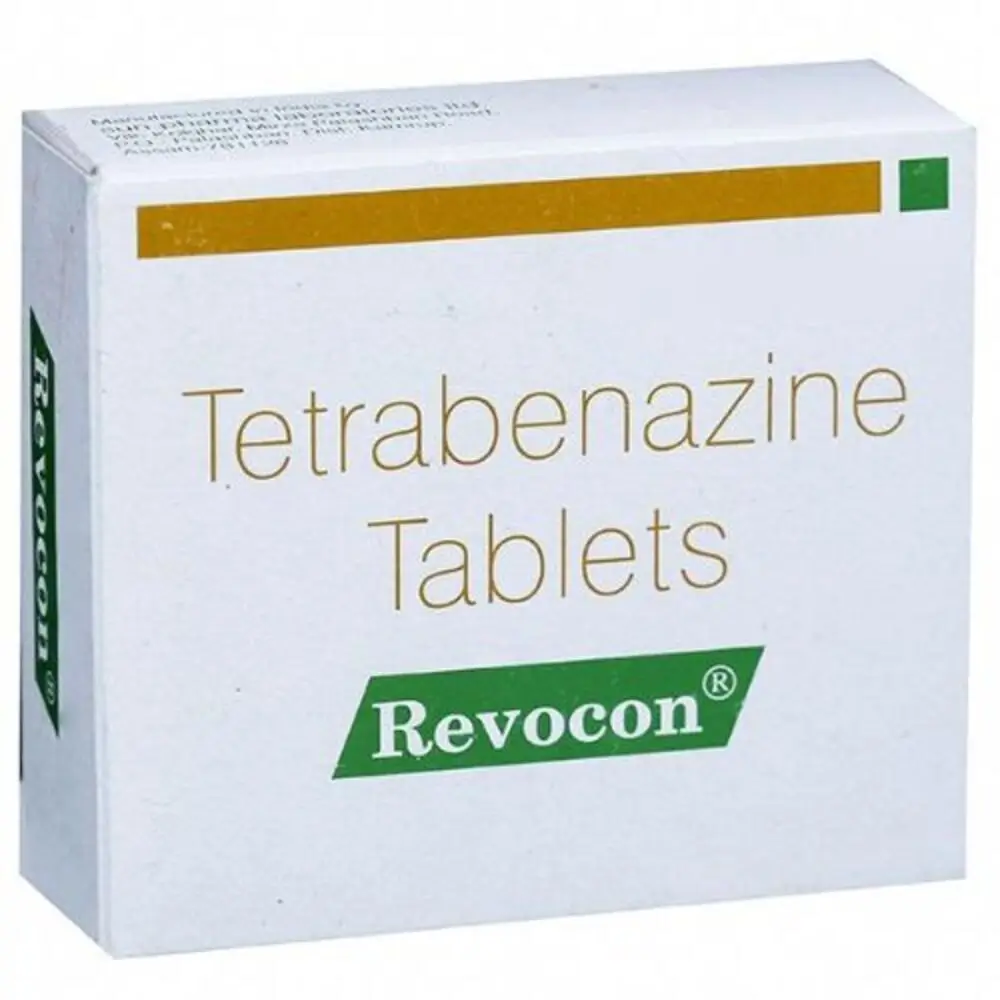
Revocon 25mg (Tetrabenazine)
Previous product
Intalith CR 450mg (Lithium Carbonate)
$10.00 $20.00Price range: $10.00 through $20.00
Next product
Flunil 40mg (Fluoxetine)
$22.50 $53.75Price range: $22.50 through $53.75
$36.00 $81.25Price range: $36.00 through $81.25
In Stock
In Stock
Revocon 25mg (Tetrabenazine)
| Pack Size | Price | Quantity | Add To Cart | |
|---|---|---|---|---|
| 30 Tablet/s | $36.00 | |||
| 60 Tablet/s | $57.50 | |||
| 90 Tablet/s | $81.25 | |||
| Want to order in bulk / B2B price? Send Inquiry | ||||
×
Sorry!! Out of Stock
Sorry! Revocon 25mg (Tetrabenazine) is out of stock
Please click below to view other similar medications.
View All Tetrabenazine Products

Offer You Can't Resist
Free Shipping
Enjoy Free Shipping on Orders above AUD304 (USD199)
Estimate Shipping :
08 June - 15 June
39
Last Updated on May 18, 2026

Description
Introduction
Revocon 25mg is a drug that contains Tetrabenazine, a drug utilized to treat disorders of movement due to abnormal, involuntary movement like chorea, which is a complication to Huntington’s disease. It’s categorized as a vesicular monoamine transporter 2 (VMAT2) inhibitor. It can be effective in slowing excessive movement by regulating neurotransmitter function within the brain.
What is Tetrabenazine?
Tetrabenazine is a neuroleptic drug for neuroleptics that inhibits the vesicular monamine transporter of type 2 (VMAT2) selectively. VMAT2 is the one responsible for transporting monoamines like serotonin, dopamine, as well as norepinephrine and histamine — to synaptic vesicles inside presynaptic neurons. Inhibiting VMAT2, tetrabenazine decreases the concentrations of these neurotransmitters found in nerve terminals, specifically dopamine. This plays a significant role in regulating the movement.
Indications and Uses of Revocon 25 mg
The Revocon 25mg tablet is intended for:
- Chorea associated with Huntington’s disease: Reduce involuntary, irregular, or jerky movement.
- Tardive dyskinesia: For managing abnormal, involuntary movement that is caused by the long-term usage of neuroleptic medications (off-label treatment).
- Other hyperkinetic movement disorders: Sometimes, it is used to treat other conditions that are characterized by high levels of motor activity, for example, dystonia and certain kinds of Tremors (off-label).
Mechanism of Action
Tetrabenazine is a drug that binds to VMAT2 inside the presynaptic neuron. VMAT2 typically packs neurotransmitters such as dopamine into vesicles that release them in the synaptic cell. When tetrabenazine inhibits VMAT2:
- Monoamines’ absorption into synaptic vesicles is reduced.
- Cytoplasmic monoamines can be metabolized through monoamine oxidase.
- The result is a lower release of monoamines, including dopamine, in the synaptic cleft.
- In the end, there is less dopaminergic neural transmission in the brain. This helps to limit hyperkinetic motions.
Pharmacokinetics
- Absorption: Tetrabenazine absorbs quickly after the administration of oral medication.
- Metabolism: It is extensively processed in the liver by CYP2D6 into active metabolic products.
- Half-life: The half-life ranges from 4 to 8 hours and can differ based on your individual metabolism rates.
- Excretion: Metabolites are mostly excreted via urine.
Dosage and Administration
- Initial Dose: The usual dosage is 12.5 mg every two days.
- Titration: The dosage can be gradually increased with steps of 12.5 mg each week, based on response to the treatment and its tolerance.
- Maintenance Dose: The dosage for a day can range from 25 mg to 100 mg. It is divided into three or two doses.
- Maximum Dose: Most often, it is not more than 100 mg a day.
- Administration: Take orally or with or without food.
- Dose Adjustments: It is required in patients suffering from hepatic impairment or who are poor CYP2D6 metabolizers.
- Special Considerations: Beware of abrupt withdrawal because it could aggravate symptoms and lead to withdrawal.
Side Effects of Revocon (Tetrabenazine)
Tetrabenazine may cause a variety of adverse reactions, some of which may be very serious. It’s important to observe the patient closely, particularly during dosage escalation.
Common Side Effects
- Sedation or drowsiness
- Fatigue or weakness
- Depression and mood changes
- Parkinsonism symptoms such as tremor, rigidity, or bradykinesia
- Anxiety or agitation
- Nausea and gastrointestinal discomfort
- Insomnia
Serious Side Effects
- Depression and Suicidal Ideation: There’s a danger of having depression or suicidal thinking, specifically in people who suffer from Huntington’s Disease. It is imperative to monitor psychiatric disorders closely.
- Extrapyramidal symptoms: Tetrabenazine can worsen movement disorders like parkinsonism or dystonia.
- Neuroleptic malignant syndrome: A rare but life-threatening condition with symptoms of fever, muscle rigidity, and autonomic dysfunction.
- Hypotension and dizziness: The risk of falling is caused by postural hypotension.
- QT prolongation: In rare instances, tetrabenazine may affect heart rate.
Precautions and Contraindications
- Psychiatric Conditions: Be cautious when using this medication if you have an underlying history of depression, suicidal thoughts, or any other psychosomatic issues.
- Pregnancy and Lactation: Only limited safety data; Use only when the benefits are greater than the risks.
- Liver Impairment: Dosage adjustments are required in the case of hepatic dysfunction.
- Concomitant Medications: Be cautious when using other medicines that can affect your central nervous system, especially the ones that create depression or increase the QT intervals.
- Elderly Patients: They may be more sensitive to negative side effects, such as the effects of hypotension and sedation.
- Driving and Operating Machinery: Patients must be aware that Tetrabenazine can reduce alertness.
Drug Interactions
- CYP2D6 inhibitors: The use of drugs such as fluoxetine, quinidine, and paroxetine may raise plasma levels of tetrabenazine, leading to a higher risk of adverse side effects.
- Monoamine oxidase inhibitors (MAOIs): It is not recommended to use it with tetrabenazine.
- Other CNS depressants: Increased sedation and depression of the CNS.
- Antipsychotics and antidepressants: Careful monitoring is necessary in order to avoid additive CNS impacts.
Monitoring During Treatment
- Mental health: Screening for depression is a regular practice, as are suicidal thoughts.
- Movement disorders: Check for the presence of worsening Parkinsonism and any other symptoms that are not related to Parkinsonism.
- Vital signs: Examine blood pressure levels for hypotension.
- Cardiac monitoring: ECG for patients who are at risk for arrhythmias.
- Liver function: The tests for liver enzymes are routinely conducted in patients who have liver impairment.
Patient Counseling and Lifestyle Advice
- Begin by taking a dose that is low and gradually increase the dosage under the supervision of a medical professional.
- Informing caregivers and patients of the possibility of mental health issues and suicidal thinking.
- Recommend patients not to drink alcohol or other CNS depressants when using Revocon.
- Inform people about the risk of being sedated and the necessity of not driving or using heavy equipment until the medication’s effect is established.
- Make sure you adhere to the prescribed dosage times and avoid stopping the medication suddenly.
- Consider the necessity of regularly scheduled check-ups for physical health as well as mental wellness.
Summary
Revocon 25 mg (Tetrabenazine) is a successful treatment for the symptoms of hyperkinetic movements, especially the chorea that is associated with Huntington’s disease. The mechanism behind it is specific VMAT2 inhibition that reduces dopaminergic activity within the brain, assisting in controlling the involuntary movement.
Though it’s effective, tetrabenazine demands cautious dosage and surveillance to avoid potential adverse reactions such as depression, sedation, and Parkinsonism. Close psychiatric surveillance and patient knowledge are essential to the safe and efficient treatment.
Related products




Recently Viewed
Reviews
There are no reviews yet.