
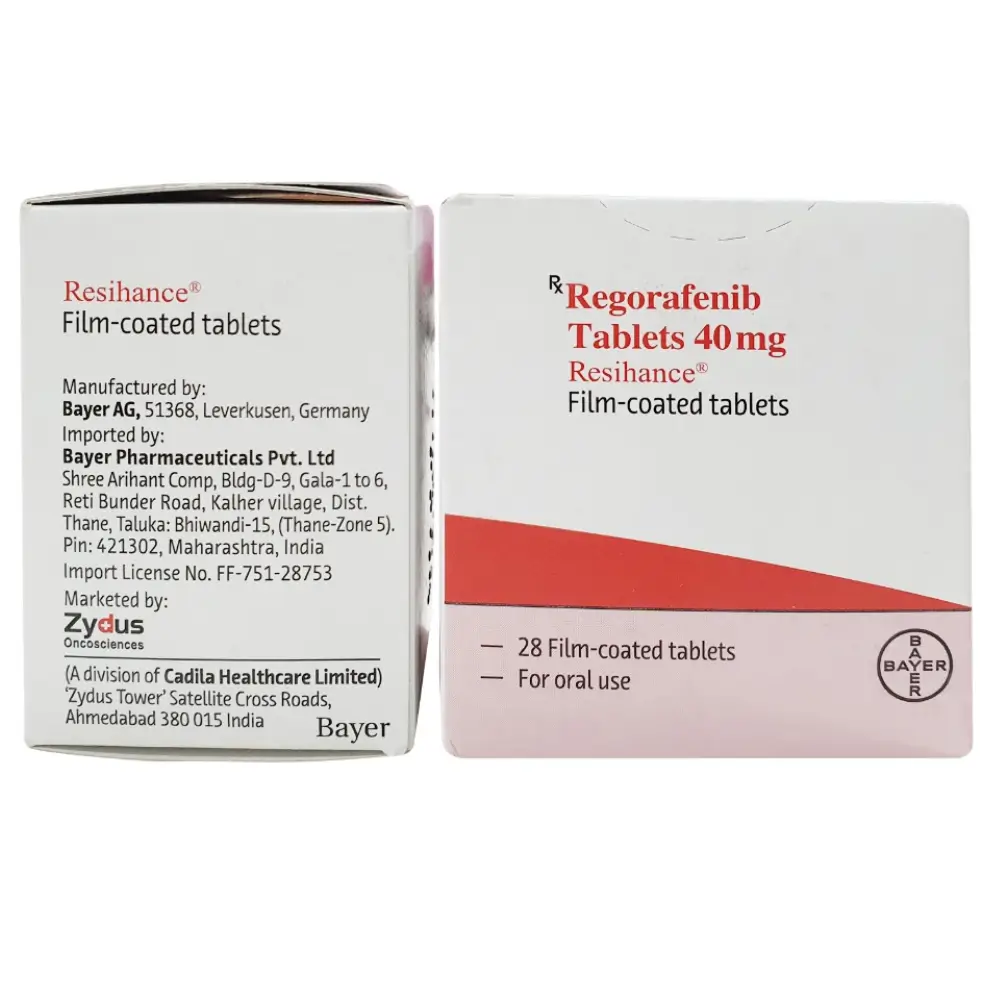
Resihance (Regorafenib)
Previous product
Antreol 1mg (Anastrozole)
A$40.43 A$118.41Price range: A$40.43 through A$118.41
Next product
Hydrea (Hydroxyurea)
A$27.44 A$79.42Price range: A$27.44 through A$79.42
A$1,010.80 A$2,873.56Price range: A$1,010.80 through A$2,873.56
In Stock
In Stock
Resihance (Regorafenib)
| Pack Size | Price | Quantity | Add To Cart | |
|---|---|---|---|---|
| 28 Tablet/s | A$1,010.80 | |||
| 56 Tablet/s | A$1,949.40 | |||
| 84 Tablet/s | A$2,873.56 | |||
| Want to order in bulk / B2B price? Send Inquiry | ||||
×
Sorry!! Out of Stock
Sorry! Resihance (Regorafenib) is out of stock
Please click below to view other similar medications.
View All Regorafenib Products
Offer You Can't Resist
Free Shipping
Enjoy Free Shipping on Orders above AUD304 (USD199)
Estimate Shipping :
19 July - 26 July
36
Last Updated on May 18, 2026

Description
Resihance (Regorafenib)
Resihance is the brand name used by Regorafenib An oral targeted therapy medicine that is used to treat specific types of cancer that are advanced cancer. Regorafenib is considered to be a multi-kinase inhibitor that works by blocking various protein kinases that are involved in angiogenesis (formation of blood vessels) as well as cancer progression.
The treatment is typically prescribed to patients suffering from metastatic colorectal carcinoma and gastrointestinal stromal tumors (GIST) and Hepatocellular Cancer (HCC), specifically when other treatment options are ineffective, or the cancer has advanced.
Pharmacology and Mechanism of Action
Regorafenib blocks multiple kinases that have roles to play in cancer growth and advancement, including:
- VEGFR1, VEGFR2, VEGFR3 (Vascular Endothelial Growth Factor Receptors): The receptors stimulate tumor angiogenesis. By blocking them, you reduce blood flow to tumors.
- PDGFR (Platelet-Derived Growth Factor Receptor): Participates in the support of stromal cells and stabilization of blood vessels.
- KIT, RET, RAF kinases: These cells are part of signals to cells, which regulate the proliferation of tumor cells and their survival of tumor cells.
By blocking the kinases that are involved, Regorafenib blocks tumor blood vessel development, the growth of cancer cells, as well as metastatic spreading, and slows the progression of the disease.
Indications and Uses
Resihance (Regorafenib) has been approved as a treatment of several cancers that are advanced that include:
- Metastatic Colorectal Cancer (mCRC): For patients whose disease is growing after treatment with conventional chemotherapy or targeted drugs.
- Gastrointestinal Stromal Tumors (GIST): Patients who have not had success with treatment with sunitinib or imatinib.
- Hepatocellular Carcinoma (HCC): Patients with advanced liver cancer who had previously been treated with sorafenib.
Regorafenib can be used in cases where other therapies are ineffective and provides a specific treatment for cancers that are difficult or impossible to treat.
Dosage and Administration
Regorafenib is taken orally via tablets. The dose that is recommended for adults is:
- 160 mg once daily during the initial 21 days in a 28-day course, and then seven days without treatment.
The tablets are best taken in conjunction with a diet low in fat for optimal absorption. This will also reduce adverse effects on the stomach. The tablets should be swallowed whole, without breaking or chewing.
The dosage adjustments are according to the tolerance of patients and their adverse reactions. The physician monitors the liver’s function as well as other indicators closely. They may cut down or stop the treatment temporarily to reduce adverse effects.
Side Effects and Adverse Reactions
Regorafenib, as with many other treatments for cancer, comes with various negative side effects, some that can be severe. Some of the most frequent side effects include:
- Hand-Foot Skin Reaction: Redness, swelling, as well as peeling and scaly skin on soles and palms.
- Fatigue: Tiredness and weakness.
- Diarrhea and Gastrointestinal Disturbances: Including nausea, vomiting, and abdominal pain.
- Hypertension: High blood pressures, which require surveillance.
- Rash and Skin Disorders: Including dry skin, itching, and sometimes blistering.
- Hepatotoxicity: Increases in liver enzymes and, in rare instances, extreme liver damage.
- Infections: Because of a weak immune system.
- Bleeding: Hemorrhage risk, in particular when patients have tumors that invade blood vessels.
- Cardiac Events: In addition, heart failure and arrhythmias can be seen in very rare instances.
The patient’s condition must be closely monitored for any serious or persistent symptoms that call for medical attention.
Contraindications and Precautions
Regorafenib is not recommended when patients are:
- Are hypersensitive to Regorafenib or one of its constituents.
- Have severe hepatic impairment.
- If you are pregnant or nursing, it could cause harm to your fetus.
Precautions include:
- Close monitoring of tests for liver function before as well as during treatment because of the risk of Hepatotoxicity.
- Continuous blood pressure monitoring as well as treatment of hypertension.
- The evaluation of cardiac function should be done with care when patients have a history of heart problems.
- It is not recommended for patients suffering from an active hemorrhagic condition.
- Be cautious when using this method for the elderly and in those who have impaired performance.
Drug Interactions
Regorafenib is mostly metabolized via liver enzyme CYP3A4 and serves as a base for UGT1A9. Thus, interactions with other medicines that alter these enzymes must be taken into consideration:
- CYP3A4 Inducers: Like rifampicin, Phenytoin such as rifampicin, phenytoin as well as St. John’s Wort, could decrease Regorafenib levels and could decrease its effectiveness.
- CYP3A4 Inhibitors: Like ketoconazole or clarithromycin. These drugs can boost Regorafenib levels, raising the chance of toxicity.
- Anticoagulants: Regorafenib could increase the risk of bleeding. So, concurrent use should be taken with caution.
- Other Hepatotoxic Drugs: The combination of use and alcohol can raise the risk of suffering from liver damage.
Always inform the healthcare professional of the use of any medication or supplement prior to taking Regorafenib.
Monitoring During Treatment
Resihance patients require continuous monitors, such as:
- Tests on the function of the liver (ALT, AST, bilirubin) to detect hepatotoxicity.
- The blood pressure monitoring for managing hypertension.
- Complete blood count to determine if there is anemia, for example, thrombocytopenia, and neutropenia.
- Physical exam focused on the condition of the skin for the detection of hand-foot syndrome, or skin rash.
- Evaluation of the cardiac system is indicated by the patient’s medical history.
- A regular assessment of the symptoms to alter dosages or treat side effects immediately.
Patient Counseling and Lifestyle Advice
Patients who are prescribed Regorafenib must be educated on:
- The medication should be taken exactly as it is prescribed, and eating a diet low in fat should be followed.
- Early reporting of side effects, including skin conditions, diarrhea, or indications of bleeding.
- Beware of grapefruit juice and grapefruit, as they can alter the metabolism of drugs.
- Checking blood pressure regularly.
- Preventing pregnancy while treatment is done, as well as using effective contraception.
- Regular periodic follow-up visits as well as laboratory testing.
- Hand-foot problems can be prevented by moisturizing your skin, staying away from tight footwear that is tight, and protecting your feet and hands.
Clinical Effectiveness and Research
Clinical studies have demonstrated that Regorafenib can improve prognosis-free and overall survival for patients suffering from advanced colorectal cancers, GIST, and Hepatocellular Cancer after failing standard therapies. This is an excellent treatment option for those with few treatment options.
The research continues to explore Regorafenib’s potential use in the treatment of other cancers, and when combined in combination with targeted treatments as well as immunotherapies.
Summary
Resihance (Regorafenib) is an inhibitor of multi-kinase function that is used to treat cancers that are advanced, like metastatic colorectal cancer, GIST, and hepatocellular cancer. By blocking key pathways involved in promoting tumor growth as well as the development of blood vessels and disease progression, it reduces.
In the form of oral medication and requiring strict dose monitoring and dosage control, Regorafenib offers hope for those with few treatment options. Be aware that the potential effect of drugs, side effects, as well as close supervision by a physician is vital to make sure that the drug is safe and effective.
Additional Information
| Manufacturer | Bayer Zydus Pharma |
|---|---|
| Pharmaceutical | Tablet/s |
| Strength | 40 mg |
| Pack Size | 28 Tablet/s, 56 Tablet/s, 84 Tablet/s |
Related products

Reviews
There are no reviews yet.