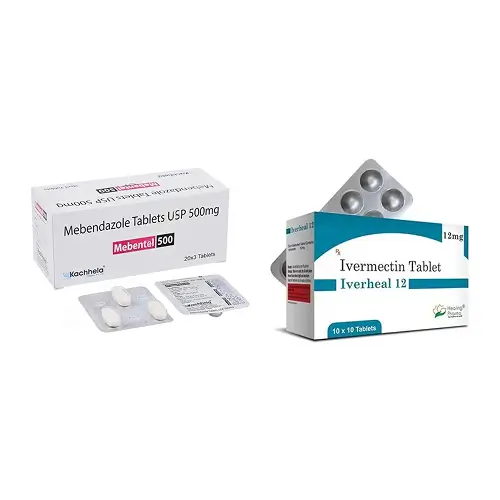
Mebendazole 500+Ivermectin 12
Previous product
Mebendazole 500+Ivermectin 6
$102.00 $296.00Price range: $102.00 through $296.00
Next product
Mebendazole 100+Ivermectin 3
$80.00 $230.00Price range: $80.00 through $230.00
$114.00 $332.00Price range: $114.00 through $332.00
In Stock
In Stock
Mebendazole 500+Ivermectin 12
| Pack Size | Price | Quantity | Add To Cart | |
|---|---|---|---|---|
| 1 Pack | $114.00 | |||
| 2 Pack/s | $222.00 | |||
| 3 Pack/s | $332.00 | |||
| Want to order in bulk / B2B price? Send Inquiry | ||||
Offer You Can't Resist
Free Shipping
Enjoy Free Shipping on Orders above AUD304 (USD199)
Estimate Shipping :
29 August - 05 September
45
Secure Packaging
My order was packaged carefully and arrived in good condition. The whole process was handled professionally, and communication was excellent. Thank you for the great service
 Australia
August 18, 2026
Last Updated on April 20, 2026

Description
Introduction
The combo of Mebendazole 500 mg and Ivermectin 12 mg can be used to treat a variety of parasitic diseases. Both of them are antiparasitic, but have different methods of action and can be effective against various forms of parasites.
- Mebendazole can be described as an anthelmintic with a broad spectrum of effectiveness, which is effective against intestinal worms such as whipworms and roundworms, as well as hookworms and pinworms.
- Ivermectin is an effective antiparasitic that is effective against a variety of parasites. It includes intestinal parasites as well as external parasites such as scabies and lice.
The treatment is usually used in locations in which multiple parasite infections are frequent, and provides a simple treatment for co-infected infections.
Mechanism of Action
Mebendazole
- Mebendazole inhibits the formation of microtubules in parasitic worms.
- It blocks the glucose uptake process and decreases energy reserves. This leads to death and immobilization of parasites.
- It is primarily a parasite of the digestive parasites.
Ivermectin
- Ivermectin has been shown to bind selectively to glutamate chloride channels within the muscle and nerve cells of parasites.
- The result is increased chloride ion permeability, hyperpolarization, and paralysis. The death of the parasite.
- It’s very efficient, and it is effective against the nematodes as well as the ectoparasites.
Indications
This is the combination that’s used to indicate:
- Treatment for intestinal helminthic infections, which include roundworms, hookworms, whipworms, and threadworms.
- Treatment for the condition known as strongyloidiasis, as well as Onchocerciasis (river blindness), by the use of ivermectin.
- Treatment for Scabies or lice infestations (primarily the use of ivermectin).
- Conditions that require broad-spectrum antiparasitic treatment.
Dosage and Administration
- Mebendazole: Most often, it is given in a 500mg single dose. It can be repeated every two weeks, based on the condition.
- Ivermectin: Most commonly, it is dosed in one dose of 12 mg, dependent on weight (approx. 150-200 mcg/kg). The dosage is based on the nature of the infection as well as its severity.
Important: Follow the health professional’s guidelines regarding frequency and dosage.
Pharmacokinetics
Mebendazole
- It is not well absorbed through the gastrointestinal tract; it is mostly active locally within the intestinal tract.
- The liver is a metabolic organ, and it’s eliminated mainly through Feces.
Ivermectin
- It is well-absorbed and digestible orally.
- The peak plasma concentration is reached within about 4-5 hours.
- The liver is metabolized through CYP3A4.
- Most is excreted in Feces.
Side Effects
The two drugs are typically accepted; certain side effects may occur.
Common Side Effects
Mebendazole:
- Abdominal pain
- Diarrhea
- Nausea and vomiting
- Headache
Ivermectin:
- Dizziness
- Fatigue
- Nausea
- Diarrhea
- Mild skin rash or itching
Rare but Serious Side Effects
- Allergic reactions
- Severe skin reactions
- Brain-related effects such as confusion or seizures (very uncommon, usually in high parasite load)
- Liver enzyme elevation
Precautions and Contraindications
- Pregnancy and breastfeeding: The two drugs must be taken cautiously. Mebendazole is generally avoided during the first trimester. Ivermectin shouldn’t be taken for use during pregnancy period or while breastfeeding, unless absolutely needed.
- Liver or kidney impairment: Be cautious, and dosage adjustments could be necessary.
- Neurological conditions: Patients suffering from CNS issues should be monitored closely due to the possibility of neurotoxic consequences.
- Allergic reactions: A hypersensitivity test to one medication is a reason to avoid its use.
Drug Interactions
- Ivermectin is converted into metabolites through CYP3A4; therefore, concurrent usage of powerful CYP3A4 inhibitors (e.g, ketoconazole, erythromycin) can increase the levels of ivermectin.
- Mebendazole could be in a relationship with cimetidine or other medications that alter liver metabolism.
Be sure to inform your doctor about any medications you’re taking.
Patient Counseling and Lifestyle Advice
- Eat the medication along with meals to increase absorption and decrease stomach discomfort.
- Be sure to maintain a clean and healthy lifestyle in order to stop the spread of infection. This includes washing your hands and staying clear of food or even drinking water.
- To treat lice or scabies, ensure that you follow the hygiene guidelines and cleaning guidelines to stop the transmission.
- Take the entire course, regardless of whether symptoms improve in the early stages.
- Notify us immediately of any adverse reaction or adverse side effect.
Summary
A combination such as Mebendazole 500mg + Ivermectin 12mg offers broad-spectrum antiparasitic protection effective in the treatment of various types of parasitic illnesses. Through targeting various parasites by employing different mechanisms, this combination is highly beneficial in locations with different levels of parasite burden.
Additional Information
| Manufacturer | Healing Pharma, India, Kachhela Medex Pvt.Ltd |
|---|---|
| Pharmaceutical | Tablet/s |
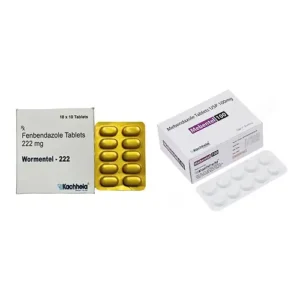
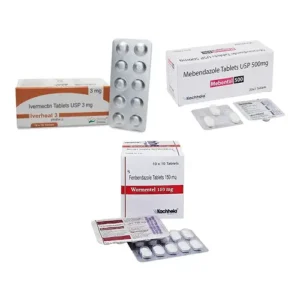
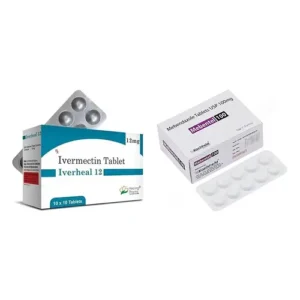
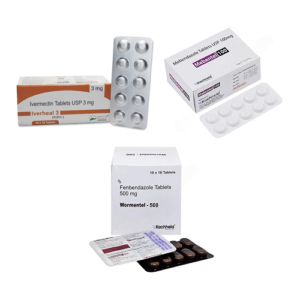
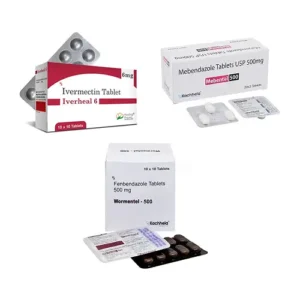
| Tablet/s | Mebentel 500mg (Mebendazole) = 60 Pills, Iverheal 12mg (ivermectin) = 60 Pills |
Related products