
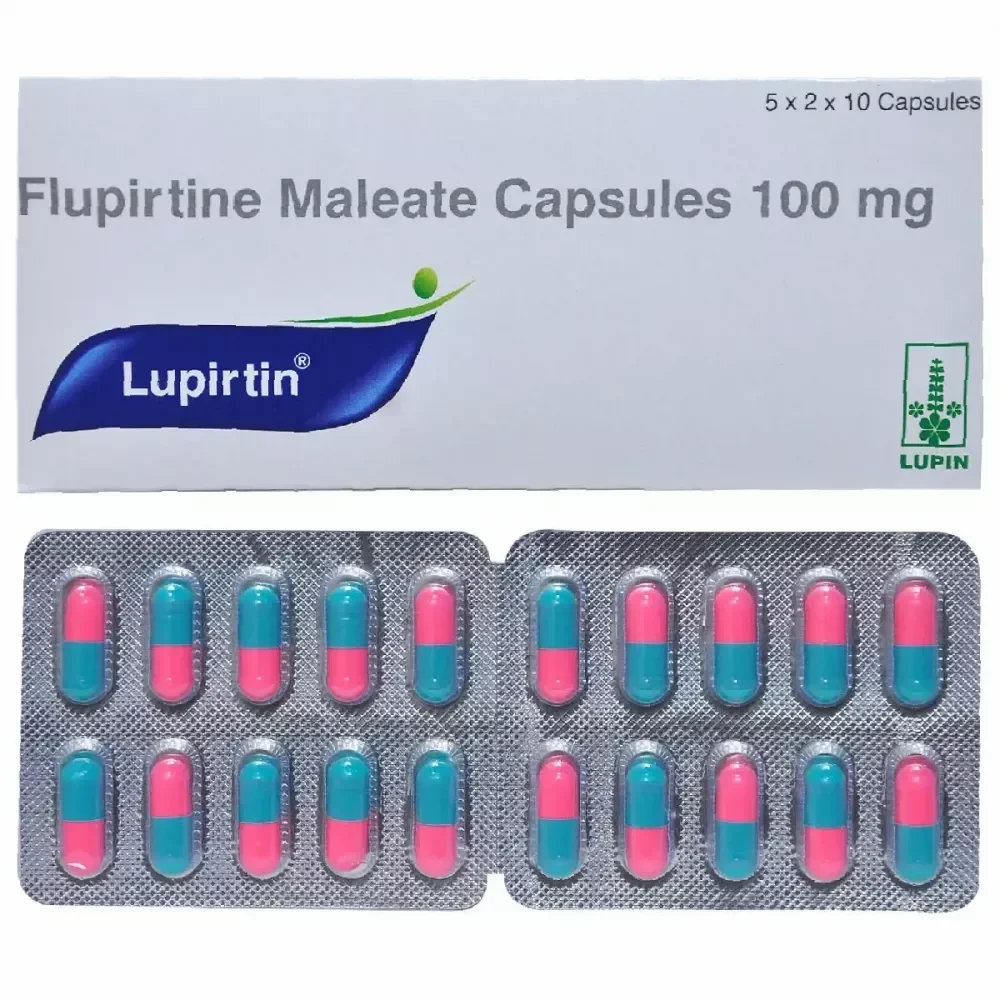
Lupirtin 100mg (Flupirtine)
Previous product
LuciFine 10mg (Finerenone)
$28.00 $71.40Price range: $28.00 through $71.40
Next product

Luporal Capsule (Tegafur/Uracil)
$124.00 $349.00Price range: $124.00 through $349.00
$63.00 $143.75Price range: $63.00 through $143.75
In Stock
In Stock
Lupirtin 100mg (Flupirtine)
| Pack Size | Price | Quantity | Add To Cart | |
|---|---|---|---|---|
| 90 Capsule/s | $63.00 | |||
| 180 Capsule/s | $97.50 | |||
| 270 Capsule/s | $143.75 | |||
| Want to order in bulk / B2B price? Send Inquiry | ||||
×
Sorry!! Out of Stock
Sorry! Lupirtin 100mg (Flupirtine) is out of stock
Please click below to view other similar medications.
View All Flupirtine Products
Offer You Can't Resist
Free Shipping
Enjoy Free Shipping on Orders above AUD304 (USD199)
Estimate Shipping :
07 June - 14 June
44
Last Updated on April 19, 2026

Description
Introduction
Lupirtin 100mg is a medicine that contains flupirtine, which is a unique analgesic as well as a muscle relaxant. It’s used to treat moderate or severe discomfort, particularly when the nerve or muscle is at play. Contrary to conventional painkillers, such as opioids or NSAIDs, Flupirtine operates through a unique mechanism that is beneficial for certain chronic pain disorders.
What is Flupirtine?
Flupirtine is a centrally-acting non-opioid analgesic that has muscle relaxant properties. The first time it was introduced was in the latter half of 1980 and was widely used throughout Europe, as well as a few Asian nations. It is effective for managing pain that is caused by muscle and joint disorders, neuropathy, and migraine.
Mechanism of Action
The way that Flupirtine works is different from the usual painkillers:
- Selective neuronal potassium channel opener: It stimulates potassium channels within nerve cells. This causes an increase in polarization (making neurons less excitable). This decreases the transmission of pain.
- NMDA receptor antagonist: In addition, it inhibits N-methyl-D aspartate (NMDA) receptor function and contributes to its analgesic effects.
- Muscle relaxant effect: Flupirtine eases the skeletal muscles that help ease the pain and muscle spasms that accompany them.
Indications
Lupirtin 100mg is prescribed for:
- Acute and chronic musculoskeletal pain:
This includes neck pain, back pain, or post-traumatic pain. - Neuropathic pain:
For example, diabetic neuropathy as well as postherpetic neuralgia. - Migraine and tension headaches:
To relieve pain and relax muscles. - Postoperative pain:
Sometimes as a treatment adjunct. - Other painful conditions:
In cases where muscle spasms or nerve irritation can be a contributing factor.
Dosage and Administration
- Adult dose:
In general, 100 mg is taken 3 times a day. The dosage can be altered according to the severity of pain as well as the response of patients. - Duration:
Most often, it is recommended to use it for short-term usage (up to two weeks). The long-term use of the drug is not recommended because of the risk. - Administration:
Tablets taken orally in conjunction with water, usually at the end of meals, to ease gastrointestinal discomfort.
Pharmacokinetics
- Absorption: Fastly absorbed, with the highest plasma concentrations within 30-60 minutes.
- Metabolism: It is extensively metabolized by the liver by demethylation as well as conjugation.
- Half-life: Approximately 6 to 8 hours.
- Excretion: Mostly eliminated by Feces and urine.
Side Effects
Flupirtine is usually well-tolerated. However, side effects may happen:
Common side effects:
- Dizziness or vertigo
- Fatigue or drowsiness
- Nausea or gastrointestinal upset
- Dry mouth
- Headache
Serious but rare side effects:
- Hepatotoxicity (liver toxicity):
- Flupirtine is associated with grave liver injuries in certain patients, such as instances of acute liver failure.
- Liver function should be checked often during treatment, and especially when treatment lasts longer than 2 weeks.
- Allergic reactions (rash, itching)
- Hypotension (low blood pressure) in some cases
- CNS effects include hallucinations or confusion (rare)
Warnings and Precautions
- Liver toxicity risk:
- Avoid using Lupirtin for longer than 2 weeks at a time.
- Check for test for liver function (LFTs) before starting treatment, and continue to do so regularly throughout the duration of the course.
- Do not advise patients who have an existing liver condition.
- Contraindications:
- Severe liver impairment
- A known hypersensitivity reaction to Flupirtine or other excipients
- Beware of use by children and teenagers under 18 (safety has not been established).
- Use with caution:
- Patients who are older or who suffer from kidney disease.
- Do not drink alcohol while taking treatment since it could cause more side effects.
- Pregnancy and breastfeeding:
- Make use of only when clearly required or prescribed by a physician.
- There are few safety data available, typically not recommended.
Drug Interactions
- CNS depressants:
The combination of benzodiazepines, sedatives, and alcohol, or benzodiazepines can cause dizziness, drowsiness, and sleepiness. - Hepatotoxic drugs:
Take care when taking other medications that affect the liver. - Enzyme inducers/inhibitors:
Certain drugs that affect liver enzymes (CYP450 system) can change Flupirtine metabolism.
How to Store Lupirtin 100mg
- Keep it in a cool, dry location in a dark, dry place away from direct sunlight.
- Make sure that the area is safe for young children.
- Keep at room temperature (typically at or below 25°C).
- Don’t use the product after the expiry date.
Patient Counseling Information
- Use only as directed. Do not exceed the prescribed dosage or duration.
- You should be aware of symptoms like the eyes or skin becoming yellow and dark urine. Also, you may experience severe abdominal discomfort (signs of liver issues).
- Beware of alcohol and CNS depressants while you are taking treatment.
- Remain in a seated or lying position if you experience dizziness.
- Inform your healthcare provider about any other medication you take.
Comparisons and Alternatives
It is often prescribed in situations where conventional NSAIDs, as well as opioids, are not recommended or not effective. But, due to the potential for liver poisoning, numerous countries have banned its usage or eliminated it from sale.
Alternatives for pain relief include:
- NSAIDs (ibuprofen, naproxen)
- Acetaminophen (paracetamol)
- Opioids (for severe pain under supervision)
- Muscle relaxants (like cyclobenzaprine)
- Anticonvulsants (for neuropathic pain, e.g., gabapentin)
Regulatory Status
Because of safety concerns about liver toxicities, Flupirtine use has been limited or stopped in certain nations. For others, it’s in use, however, with several warnings and a limited time limit for use.
Summary Table
| Aspect | Details |
| Drug Name | Lupirtin 100mg (Flupirtine) |
| Class | Non-opioid analgesic, muscle relaxant |
| Indications | Musculoskeletal pain, neuropathic pain, migraine |
| Typical Dose | 100 mg three times daily |
| Mechanism | Potassium channel opener, NMDA antagonist |
| Common Side Effects | Dizziness, fatigue, nausea |
| Serious Side Effects | Hepatotoxicity, allergic reactions |
| Duration of Use | Max 2 weeks |
| Monitoring | Liver function tests |
| Contraindications | Liver disease, hypersensitivity |
Conclusion
Lupirtin 100mg (Flupirtine) is a distinctive and efficient pain relief solution to treat certain kinds of pain. It is particularly effective where muscle relaxation is required along with analgesia. But the possibility of liver toxicity means that it needs to be handled with care, typically only for short periods and with strict supervision from a medical professional. Patients must be informed about potential risks and monitored often while receiving treatment.
Additional Information
| Active Ingredient: | Flupirtine |
|---|---|
| Indication: | Musculo-Skeletal Pain and Headache and Nerve Pain |
| Manufacturer: | Lupin Limited |
| Strength: | 100mg |
| Packaging: | 10 Capsules in 1 Strip |
| Delivery Time: | 7 To 15 days |
Related products





Recently Viewed
Reviews
There are no reviews yet.