
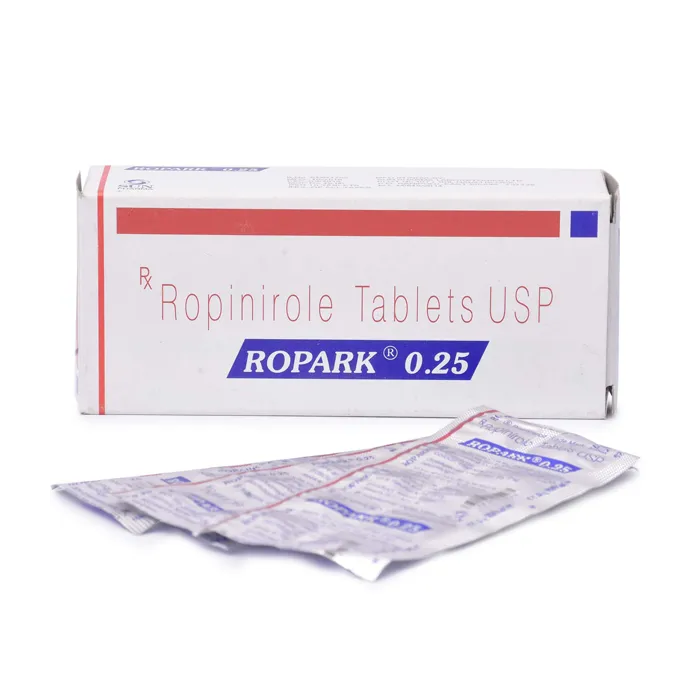
Ropark 0.25mg (Ropinirole)
Previous product

Ropark 1mg (Ropinirole)
A$33.34 A$61.42Price range: A$33.34 through A$61.42
Next product
Rizact 5mg (Rizatriptan)
A$90.55 A$280.76Price range: A$90.55 through A$280.76
A$21.06 A$38.60Price range: A$21.06 through A$38.60
In Stock
In Stock
Ropark 0.25mg (Ropinirole)
| Pack Size | Price | Quantity | Add To Cart | |
|---|---|---|---|---|
| 60 Tablet/s | A$21.06 | |||
| 90 Tablet/s | A$29.83 | |||
| 120 Tablet/s | A$38.60 | |||
| Want to order in bulk / B2B price? Send Inquiry | ||||
×
Sorry!! Out of Stock
Sorry! Ropark 0.25mg (Ropinirole) is out of stock
Please click below to view other similar medications.
View All Ropinirole Products

Offer You Can't Resist
Free Shipping
Enjoy Free Shipping on Orders above AUD304 (USD199)
Estimate Delivery :
12 October - 19 October
29
Excellent service overall
Smooth checkout, quick dispatch, and secure delivery. Excellent service overall
 Australia
October 1, 2026
Last Updated on May 18, 2026

Description
In the field of neurology and movement disorders, specific drugs play an important role in helping patients improve their living conditions. A prime example of this can be found in Ropark 0.25mg, which is a derivative made from Ropinirole, which is commonly utilized to treat Parkinson’s disease as well as restless legs syndrome (RLS). Though the name could seem complicated, the benefit it provides patients can be significant and transformative.
In this informative blog, we’ll cover the essential information you should be aware of Ropark 0.25 mg — including its mechanism in action, the therapeutic applications, dosage, possible side effects, safety measures, as well as the research behind its effectiveness. If you’re a patient or caregiver, or just looking for information, this post is designed to address your concerns with a concise and sensible method.
What is Ropark 0.25 mg?
Ropark 0.25 mg is a formulation for pharmaceuticals that contains Ropinirole hydrochloride, which is an active dopamine agonist. It is most commonly used for treating two main ailments:
- Parkinson’s Disease (PD)
- Restless Legs Syndrome (RLS)
The tablet Ropark 0.25 mg has 0.25 mg Ropinirole, which is typically taken for the starting dosage that can be adjusted depending on the patient’s reaction and tolerance.
It is offered in tablet form that can be taken orally and can be prescribed with different brands around the world; however, Ropark is an internationally recognized name across a number of countries, including South Asia.
The Role of Dopamine in the Brain
To comprehend the ways in which Ropark is working, it’s essential to understand the function of dopamine. Dopamine is the chemical messenger (neurotransmitter) that is found in the brain. It is a key component in:
- Controlling movement
- Regulating mood
- Promoting motivation and reward
In Parkinson’s disorder, it is the case that the brain’s dopamine-producing neurons weaken with time, leading to an insufficient amount of dopamine. It can cause symptoms that include stiffness, tremors, and twitches, as well as an inability to move and impaired stability.
The cause is Restless Legs Syndrome. While the precise reason isn’t completely understood, there is a belief that an imbalance of dopamine in particular areas of the brain is responsible for the discomfort in the legs, as well as an irresistible desire to move these legs.
Ropinirole (Ropark) is akin to the effects of dopamine binding to receptors on its own, thereby compensating for its insufficiency.
Medical Uses of Ropark 0.25 mg
Parkinson’s Disease
Ropark 0.25 mg is usually used as a part of the treatment program in the beginning and later stages of Parkinson’s disease. Ropark 0.25 mg can be utilized for:
- Monotherapy at the beginning of Parkinson’s (when the symptoms are not severe)
- Adjunct therapy with levodopa (L-DOPA) in the advanced stages of Parkinson’s to control motor tremors and decrease the “off” period
Benefits:
- Reduces tremors and rigidity
- Improves mobility and coordination
- Minimizes levodopa-related complications
Restless Legs Syndrome (RLS)
RLS is a condition of the nervous system with a strong desire to move the legs. It is usually associated with discomfort, especially when you are resting or in the absence of activity.
Ropark 0.25 mg is accepted to treat moderate to severe primary RLS and aids in:
- Reducing leg discomfort
- Sleep disturbances can be reduced
- Improving overall quality of life
Dosage and Administration
Important: Ropark is best taken with the advice of a medical professional. Dosages vary based on the medical condition being treated, health, and the individual’s responses.
For Parkinson’s Disease:
- Initial dose: 0.25 mg three times daily
- Dose can be gradually increased over a few days.
- Maintenance dose: The typical dosage is between 3 mg and 9 mg daily in three dosages
- Maximum daily dose: 24 mg
For Restless Legs Syndrome:
- Usually, once a day, between 1 and 3 hours before the time of bed
- Starting dose: 0.25 mg
- Dose may be gradually increased as needed
- Maximum dose for RLS: 4 mg per day
Administration tips:
- Eat either with or without food
- Drink the entire thing with water
- Stop abruptly without medical guidance
How Ropark 0.25 mg Works: Mechanism of Action
Ropinirole is a non-ergoline dopamine antagonist that is able to bind selectively to D2 and D3 dopamine receptors within the brain. Through activation of these receptors, it assists in:
- Enhance the circuits of motor regulation that are dependent on dopamine
- Relieve the symptoms of neurological impairment that are caused by a deficiency in dopamine
- Modulate neural circuits that are involved in sensory perception as well as movements (especially for RLS)
In contrast to levodopa, this is converted into dopamine within the brain. Alternatively, ropinirole activates dopamine receptors. This provides better treatment of symptoms and reduces motor problems in the long-term course of treatment.
Side Effects of Ropark 0.25 mg
Similar to all drugs, Ropark can cause side effects. Though not everybody experiences these, it is important to be conscious of any potential dangers.
Common Side Effects:
- Nausea
- Dizziness or light-headedness
- Fatigue or drowsiness
- Headache
- Abdominal discomfort
- Vomiting
- Sleep disturbances
Less Common but Serious Side Effects:
- Sudden sleep attacks (falling asleep without warning)
- Hallucinations or confusion (especially in elderly patients)
- Compulsive behaviors (e.g., gambling, overeating, shopping)
- Orthostatic hypotension (drop in blood pressure when standing)
- The risk of dyskinesia increases in conjunction with levodopa
If any of them occur, you should seek medical attention. It is imperative to notify your medical professional of any abnormal symptoms immediately.
Special Precautions and Warnings
Ropark 0.25 mg could not be appropriate for all people. The following are some important points to be considered:
- Pregnancy and Breastfeeding
- It is only recommended to use it if the benefits that could be derived exceed the potential risks
- Do not recommend it during lactation since it can affect lactation
- Kidney or Liver Impairment
- Adjustments to dosages may be required
- Monitoring on a regular basis may be necessary
- Elderly Patients
- They may be more sensitive to adverse effects such as confusion or hallucinations
- Psychiatric History
- Averting patients with a history of psychosis and bipolar disorder. the disorder of impulse control
- Driving and Machinery
- Ropinirole may cause sleepiness or abrupt sleep-like episodes
- Beware of operating or driving large machinery until the reaction to the medication is determined
Drug Interactions
Ropark could interfere with other drugs, which could affect the effectiveness of these medications. It is important to notify your doctor of any medications you take.
Possible Interactions:
- Ciprofloxacin (can increase Ropinirole levels)
- Fluvoxamine, paroxetine (SSRIs)
- Antipsychotic medications (may reduce Ropinirole’s effectiveness)
- Estrogen-containing contraceptives (may affect drug metabolism)
- Alcohol and sedatives (increase risk of drowsiness)
Averting self-medication as well as over-the-counter drugs with no professional guidance is crucial.
Tapering and Discontinuation
Stop your intake of Ropark 0.25 mg abruptly. The discontinuation of Ropark should be taken slowly under the supervision of a medical professional to prevent withdrawal-related symptoms, such as:
- Anxiety
- Insomnia
- Worsening of Parkinsonian symptoms
- Irritability or agitation
A gradual reduction in doses lets the brain adapt and reduces the chance of rebound-related symptoms.
Comparing Ropark with Other Dopamine Agonists
Ropinirole (Ropark) is part of the same class as:
- Pramipexole
- Rotigotine
- Apomorphine
Each one has its own specific instructions as well as formulations (oral patch, injectable, etc.), as well as an adverse effects profile. The most popular use for Ropinirole is:
- Ease of oral administration
- The effectiveness of early Parkinson’s as well as RLS
- Hallucinations are less likely to occur when taking older prescription drugs
The individual’s reaction to treatment varies. Doctors make their decision based on the patient profiling, the severity of symptoms, and any comorbidities.
Patient Experience: What to Expect
Most patients report significant relief from symptoms within a couple of days or weeks after starting Ropark 0.25 mg. Some common experiences are:
- Better mobility and reduced stiffness
- Improved sleep and less leg discomfort (for RLS)
- Increased alertness during the day
But, adverse effects such as dizziness and nausea aren’t common in the first few days of treatment. If you follow the correct dose titration procedure as well as lifestyle adjustments, these tend to diminish.
A healthy relationship between doctor and patient is crucial to altering dosage, minimizing the side effects, and getting the maximum advantages.
Related products


Recently Viewed
Reviews
There are no reviews yet.