
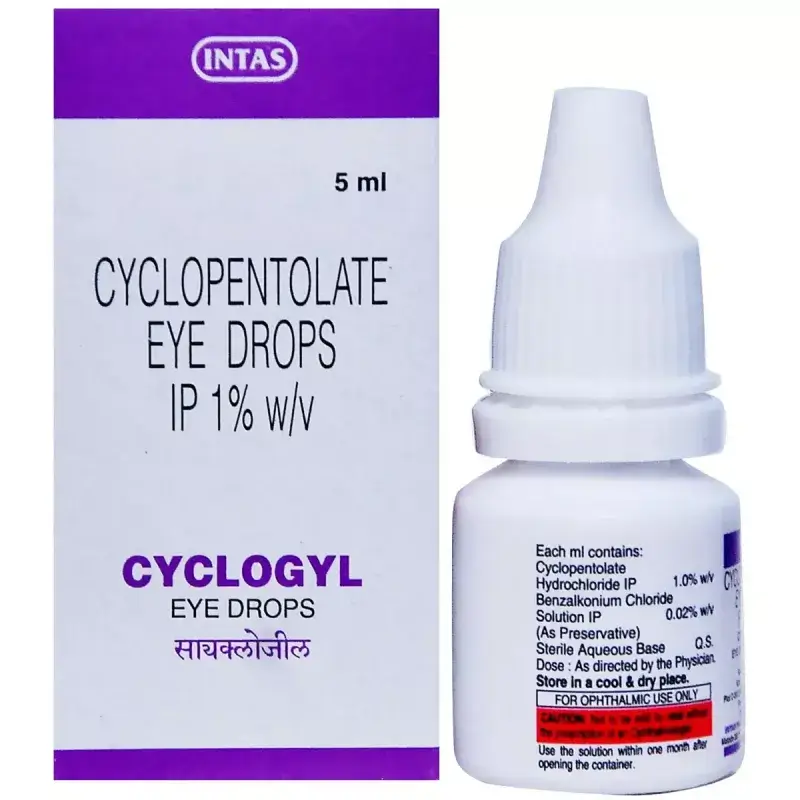
Cyclogyl Eye Drop (Cyclopentolate)
Previous product

Xalatan Eye Drops (latanoprost)
$15.00 $80.00Price range: $15.00 through $80.00
Next product
Brufen 400mg (Ibuprofen)
$5.00 $14.00Price range: $5.00 through $14.00
$10.00 $25.00Price range: $10.00 through $25.00
In Stock
In Stock
Cyclogyl Eye Drop (Cyclopentolate)
| Pack Size | Price | Quantity | Add To Cart | |
|---|---|---|---|---|
| 3 Eye Drop | $10.00 | |||
| 6 Eye Drop | $18.00 | |||
| 9 Eye Drop/s | $25.00 | |||
| Want to order in bulk / B2B price? Send Inquiry | ||||
×
Sorry!! Out of Stock
Sorry! Cyclogyl Eye Drop (Cyclopentolate) is out of stock
Please click below to view other similar medications.
View All Cyclopentolate Products
Offer You Can't Resist
Free Shipping
Enjoy Free Shipping on Orders above AUD304 (USD199)
Estimate Shipping :
14 July - 21 July
39
Last Updated on November 28, 2025

Description
Fast-Acting Eye Drop for Diagnostic Dilation & Pupil Relaxation
Cyclogyl eye drops, comprised of Cyclopentolate Hydroxychloride 1% and 1%, are used by optometrists as well as ophthalmologists for their ability to dilate (enlarge) the pupil as well as reduce tension in the eye during eye exams. The drops are effective quickly, usually within 30 to 60 minutes. They are ideal for tests of the retina, diagnostic testing, as well as some surgical procedures before surgery.
It’s a prescription drug which is used under the supervision of a physician for treatment or for diagnostics.
What Is Cyclogyl Eye Drop?
Cyclogyl has Cyclopentolate, which is one of the types of anticholinergic (muscarinic antagonist) that blocks specific receptors within the eye. It causes the pupil to expand (mydriasis) and the lens loses the ability to concentrate (cycloplegia).
These results allow the ability to conduct exact eye exams as well as, in a few situations, treatments for specific problems with the eyes. This process is reversible and usually is gone within 24 hours. However, full sight recovery could take a bit longer for certain people.
Key Features at a Glance
| Feature | Details |
| Active Ingredient | Cyclopentolate Hydrochloride 1% |
| Use | Diagnostic pupil dilation, cycloplegia |
| Form | Sterile ophthalmic solution |
| Onset of Action | 30–60 minutes |
| Duration | 24–48 hours (effects vary per person) |
| Prescription Required | Yes |
| Pack Size | Commonly 5 mL |
| Storage | Below 25°C; avoid contamination |
How Does Cyclopentolate Work?
Cyclopentolate acts through temporarily paralyzing the ciliary muscles (responsible for focusing the lens) as well as dilating the pupil. This is accomplished through blocking the muscarinic receptors within the eye. This reduces the capacity of the eye to narrow and accommodate.
This mechanism permits:
- Larger pupil access for the examination of the optic nerve and retina
- The precise measurement of refractive errors among young children (especially with hyperopia)
- A short-term solution to certain painful eye disorders by easing muscle spasms
Common Medical Uses
Cyclogyl Eye Drops can be used for:
- Eye exams that are dilated to check for retinal cancer
- Cycloplegic tests for refraction, particularly for children
- The pre-operative procedure for cataract surgery or laser eye surgery
- Treatment for Uveitis for reducing eyestrain and reducing synechiae (adhesions)
- Diagnostic tests for children to determine amblyopia or Strabismus
Directions for Use
Make sure to use Cyclogyl in accordance with the directions of your eye health professional.
Standard Dosing Guidelines:
- Adults & children >6 years: One drop for each eye. Repeated every 5-10 mins if required.
- Younger children: A lower concentration or one dose is recommended, but with care.
- Pre-operative use: Usually, the procedure is performed 30-60 minutes before the treatment.
Application Tips:
- Make sure to wash your hands clean both before and after each use.
- Reverse the head and then gently lift the lower part of your eyelid.
- Drop one drop of the sac of conjunctival fluid.
- The inner corner of your eye (lacrimal canal) for approximately 1-2 minutes to block absorption by the system.
- Do not touch the tip of your dropper on any other surface.
What to Expect After Use
| Effect | Onset | Duration |
| Pupil dilation | 30–60 minutes | 24 hours (up to 48 hrs) |
| Blurry near vision | Within 1 hour | 6–24 hours |
| Light sensitivity | Within 1 hour | Up to 48 hours |
Tip: Wear sunglasses while outdoors. Be sure to avoid reading and activities that require close-ups until your vision is restored to normal.
Safety & Side Effects
A majority of users have a temporary feeling, but this is the only issue.
Common (short-term):
- Stinging or burning on instillation
- Blurred vision (especially for close-up work)
- Light sensitivity (photophobia)
- Eye redness
Rare but Serious:
- Dry mouth
- Headache
- Drowsiness or restlessness (mainly in children)
- Allergic reaction (rash, swelling, difficulty breathing)
- Increased intraocular pressure
Important: Avoid driving or operating machines if you have difficulty seeing. Avoid children because any accidental intake of alcohol can pose a risk.
Who Should Avoid Cyclogyl?
Ask your pharmacist or doctor before using Cyclogyl. If you are suffering from:
- Glaucoma (especially angle-closure)
- Down syndrome
- Known hypersensitivity to anticholinergics
- A history of eye surgery
- Dry eye or corneal disease
- Use of MAO inhibitors or tricyclic antidepressants
Storage Instructions
- Keep it in storage at or below 25°C
- Guard against moisture and light
- Don’t use when the solution is opaque
- Discard 28 days after opening
Cyclogyl vs Other Mydriatic Agents
| Property | Cyclopentolate (Cyclogyl) | Tropicamide | Atropine |
| Onset | 30–60 minutes | 15–30 minutes | 1–3 hours |
| Duration | 24–48 hours | 4–6 hours | 7–10 days |
| Cycloplegia strength | Moderate–strong | Mild | Very strong |
| Common use | Refraction, uveitis, exams | Routine exams | Amblyopia, uveitis |
FAQs – What, How, Why?
-
What is Cyclogyl used for?
Cyclogyl helps dilate pupils and ease the ability of the eye to focus when undergoing treatments, tests, or surgical procedures.
-
How long does pupil dilation last?
The dilation typically lasts for 24 hours. However, in certain people, particularly youngsters, it may last at least up to 48 hours for the full effect to disappear.
-
Why is it used in children’s eye exams?
It provides an accurate evaluation of refractive error due to the fact that it paralyzes accommodation, which could otherwise obscure real visual issues among children.
-
Can I drive after using Cyclogyl?
No. Your vision may be temporarily fuzzy, and your pupils may be sensitive to the light. Make sure you wait until your eyesight is back to normal prior to driving.
-
Can Cyclogyl be used in both eyes?
Yes, it depends on the exam. The doctor will decide whether the eyes of one or both need dilation.
-
Does it hurt when applied?
Certain users experience the sensation of a minor burning or stinging sensation that goes away after several minutes.
-
Can I wear contact lenses after using Cyclogyl?
No. It’s best to wait for at least 24 hours until your physician has confirmed the safety of resuming wearing contact lenses.
-
What if I accidentally miss a dose?
If Cyclogyl was recommended for continuous treatment (e.g., Uveitis), apply the medication as soon as you remember. When it comes to diagnostics, the time is controlled by a doctor.
-
Is it safe for infants or toddlers?
Only in very limited circumstances and under medical surveillance. Pediatric use is associated with a greater chance of adverse effects.
-
How should I protect my eyes after application?
Wear sunglasses, and beware of the bright lights. Avoid reading or screen time until your vision is restored.
Final Thoughts
Cyclogyl eye drops (Cyclopentolate 1%) remain a trusted instrument for Australian optometry and optophthalmology. The speed of their action, the reliability of pupil dilation, and their therapeutic flexibility make them a must in both eye diagnosis as well as treatment.
Additional Information
| Manufacturer | Intas Pharmaceuticals Ltd |
|---|---|
| Pharmaceutical | Eye Drop/s |
| Strength | 0.01% |
| Pack Size | 3 Bottle/s, 6 Bottle/s, 9 Bottle/s |
Related products




Recently Viewed


Reviews
There are no reviews yet.