

Warf 5mg (Warfarin)
Previous product

Cozartan 100mg (Losartan Potassium)
$45.00 $100.00Price range: $45.00 through $100.00
Next product
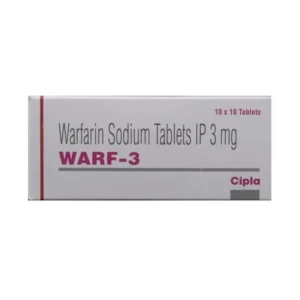
Warf 3mg (Warfarin)
$21.50 $41.80Price range: $21.50 through $41.80
$3.42 $8.64Price range: $3.42 through $8.64
In Stock
In Stock
Warf 5mg (Warfarin)
| Pack Size | Price | Quantity | Add To Cart | |
|---|---|---|---|---|
| 30 Tablet/s | $3.42 | |||
| 60 Tablet/s | $6.34 | |||
| 90 Tablet/s | $8.64 | |||
| Want to order in bulk / B2B price? Send Inquiry | ||||
×
Sorry!! Out of Stock
Sorry! Warf 5mg (Warfarin) is out of stock
Please click below to view other similar medications.
View All Warfarin Products

Offer You Can't Resist
Free Shipping
Enjoy Free Shipping on Orders above AUD304 (USD199)
Estimate Delivery :
23 October - 30 October
29
Last Updated on June 29, 2026

Description
Product Overview
Warf 5mg contains Warfarin, a widely used oral anticoagulant medication that helps to prevent the development of dangerous blood clots. Warfarin is a Vitamin K antagonist, which is used for reducing the danger of stroke and deep vein thrombosis (DVT) as well as pulmonary embolism (PE), along with other disorders caused by abnormal blood clotting. Warfarin is an important medicine in the management of thromboembolic and cardiovascular diseases.
Warf 5mg tablets were developed to be taken orally, allowing precisely controlled doses for efficient anticoagulation therapy. Due to its limited therapeutic range and the possibility of severe side effects, Warfarin therapy requires careful control and adjustment of dose according to the specific patient’s response.
Mechanism of Action
Warfarin acts by blocking the enzyme Vitamin K epoxide reductase that is essential to activate Vitamin K-dependent clotting factors II, VII, IX, and X, and Anticoagulant Proteins C as well as S. By reducing the production of these factors that cause clotting, Warfarin prevents the formation of fibrin blood clots in the bloodstream.
Warfarin’s anticoagulant action is evident over a period of several days due to its effect on the production of clotting factors rather than dissolving the existing blood clots. The delayed start requires careful treatment with bridging agents that work quickly at the time of initiation in a lot of instances.
Indications and Uses
Warf 5mg is indicated for the:
- Prevention and treatment for venous thromboembolism (VTE), including deep vein thrombosis (DVT) and pulmonary embolism (PE).
- The prevention of stroke and embolism in the system for patients suffering from atrial fibrillation (AF), as well as other heart conditions that can increase the risk of thromboembolic events.
- The management of replacement of the mechanical heart valve in order to stop valve thrombosis.
- The treatment and prevention of secondary myocardial infarction (in certain instances).
- The prevention of thromboembolic problems for patients who have prosthetic heart valves, hypercoagulable states, and other medical conditions, according to a medical physician.
Dosage and Administration
- Warf 5mg tablets can be taken in a pill form, generally once per day.
- The dosage varies for each patient, but typically ranges between 1 mg and 10 mg daily.
- The initial dose is based on medical indication, the patient’s age of the patient, weight, food habits, as well as other medicines.
- Dosage needs to be adapted according to the International Normalized Ratio (INR) monitoring to keep an ideal therapeutic range (usually INR 2.0-3.0 for the majority of indications).
- A regular INR surveillance is crucial at the beginning of the process and regularly thereafter.
- Do not stop taking Warfarin without consulting your health care physician.
Important Monitoring
- INR Monitoring: A regular check of blood is essential to determine the INR, which is a measure of blood clotting potential. Keeping the INR within a range that is in line with the desired level minimizes the chance of complications from bleeding or clotting.
- Signs of bleeding: The patient should be aware of signs such as bruising that is unusual and blood in the urine or stool, excessive bleeding, or severe headaches that are severe.
- Diet and Lifestyle: Vitamin K intake via diet could affect the effectiveness of Warfarin. Regular consumption of Vitamin K-rich food items (e.g., spinach, green vegetables) is suggested.
Side Effects
Common Side Effects:
- Mild bleeding or bruising
- Nausea or vomiting
- Diarrhea or abdominal pain
Serious Side Effects:
- Major bleeding (e.g., gastrointestinal, intracranial hemorrhage)
- Allergic reactions including rash and itching
- Purple toe syndrome (rare)
- Necrosis of skin and tissue (rare but serious)
If signs of extreme blood loss or reactions to allergens develop, you should seek immediate medical treatment.
Precautions and Warnings
- Contraindications: Warfarin isn’t recommended in those with bleeding that is active and severe kidney or liver disease, pregnancy (except for mechanical heart valves that require specialist supervision), or recent surgical procedures that have a high risk of bleeding.
- Take care when treating patients with high blood pressure, ulcers of the peptic or bleeding disorders.
- Tell your doctor about any medicines, which include over-the-counter medications supplementation, herbs, since many have interactions with Warfarin (e.g., antifungals, NSAIDs, and antibiotics, aspirin).
- Consumption of alcohol is not recommended since it could increase the effects of Warfarin as well as raise the risk of bleeding.
- Warfarin is a drug that crosses the placenta and could cause fetal bleeding and malformations. It should be avoided in pregnancy, unless it is absolutely required.
Drug Interactions
Warfarin can interact with many chemicals and drugs that are used to increase or reduce its anticoagulant properties:
- Increase bleeding risk: Aspirin, NSAIDs, antibiotics (e.g., metronidazole, ciprofloxacin), antifungals, amiodarone, and some antidepressants.
- Decrease effect: Vitamin K supplements, certain anticonvulsants (e.g., carbamazepine), and rifampin.
- Herbal supplements such as St. John’s Wort, Ginkgo biloba, Garlic, and Ginseng could also influence the metabolism of Warfarin.
Always seek the advice of a medical professional before attempting to stop or resume any medicine during Warfarin treatment.
Storage Instructions
- Place Warf 5mg tablets into an air-conditioned, dry area far from excessive sunlight and moisture.
- Make sure the medicine is away from children.
- Do not use after the expiration date.
Frequently Asked Questions (FAQs)
How long does Warfarin take to work?
Warfarin usually takes 3 to 5 days before it achieves its full anticoagulant action. In this period, additional powerful anticoagulants with a rapid-acting mechanism, like heparin, could be utilized.
What should I do if I miss a dose?
Do not miss a dose until you can remember it that same day. If you’re nearing due for your next dose, avoid the dose you missed. Don’t double-dose.
Can I eat green leafy vegetables while taking Warfarin?
Yes, however, you must keep a steady intake of Vitamin K in order to stay clear of changes in the effectiveness of Warfarin.
Is it safe to drink alcohol while on Warfarin?
Alcohol increases bleeding risks and can interfere with Warfarin. Be sure to limit alcohol consumption and speak with your doctor.
How often do I need to check my INR?
In the beginning, INR should be checked often (every couple of days) until it is stable. After that, you should check usually every two to four weeks, or at the time recommended by your physician.
Conclusion
Warf 5mg (Warfarin) is a fundamental anticoagulant treatment for preventing or treating blood clots that occur in various medical conditions. By ensuring that you are vigilant and adhere to the recommended dosage and lifestyle, Warfarin can reduce the possibility of embolism, stroke as well as other thromboembolic conditions.
Because of its intricate interactions and limited therapeutic index, the Warfarin treatment needs close medical supervision as well as patient education and modifications to lifestyles in order to guarantee the safety of patients and effectiveness.
Related products

Reviews
There are no reviews yet.