
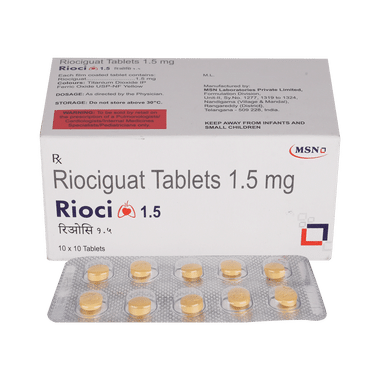
Rioci 1.5mg (Riociguat)
Previous product

Rioci 1mg (Riociguat)
$26.00 $70.00Price range: $26.00 through $70.00
Next product
Roxarivaben 15mg (Rivaroxaban)
$45.00 $115.00Price range: $45.00 through $115.00
$30.00 $84.00Price range: $30.00 through $84.00
In Stock
In Stock
Rioci 1.5mg (Riociguat)
| Pack Size | Price | Quantity | Add To Cart | |
|---|---|---|---|---|
| 30 Tablet/s | $30.00 | |||
| 60 Tablet/s | $58.00 | |||
| 90 Tablet/s | $84.00 | |||
| Want to order in bulk / B2B price? Send Inquiry | ||||
×
Sorry!! Out of Stock
Sorry! Rioci 1.5mg (Riociguat) is out of stock
Please click below to view other similar medications.
View All Riociguat Products
Offer You Can't Resist
Free Shipping
Enjoy Free Shipping on Orders above AUD304 (USD199)
Estimate Shipping :
08 June - 15 June
38
Last Updated on May 18, 2026

Description
Pulmonary hypertension (PH) is a grave chronic condition that is characterized by increased blood pressure in the arteries that supply the lungs. The increased pressure places stress on the lungs and heart and can cause symptoms such as tiredness, shortness of breath, and a decrease in exercise capacity. If left untreated, PH may significantly affect your quality of life and even be fatal.
The last few years have seen significant advances in treating pulmonary hypertension that have drastically increased the outcomes of patients. A notable breakthrough can be found in Rioci 1.5mg, whose active ingredient is Riociguat. The drug has been endorsed by different health officials across the world. Riociguat represents a novel treatment option for people with certain forms of hypertension in the pulmonary arteries.
In this blog post, we’ll go over the essential information you should learn about Rioci 1.5mg, starting with the way it functions and its usages, through its benefits as well as side effects, warnings, and patient advice.
What is Rioci 1.5mg?
Rioci 1.5mg can be described as a drug formula that contains Riociguat, which is a sulfate guanylate cyclase (sGC) stimulator. It’s administered by mouth as a tablet. Riociguat targets the Nitric oxide (NO) pathway. This can be impaired in hypertension sufferers.
The drug is indicated for:
- Pulmonary arterial hypertension (PAH): A type of PH is characterized by blockage or narrowing of the pulmonary arterial blood vessels.
- Chronic thromboembolic pulmonary hypertension (CTEPH): A kind of PH is caused by the presence of old blood clots, which are well-organized, blocking the lung vessels.
Rioci is proven to be effective in increasing fitness capacity, symptoms, and hemodynamics for the patients. It also helps improve their general quality of life.
Understanding Pulmonary Hypertension and Riociguat’s Role
The pressure of the pulmonary arteries increases in a way that is not normal, usually because of vasoconstriction, blood vessel remodeling, or even obstruction of the circulation of blood. A higher pressure makes it more difficult for the right side of the heart’s artery to carry air through the lungs. This can ultimately lead to heart failure.
One of the major processes involved in the regulation of blood flow in the pulmonary vein is the nitric oxide-soluble, guanylate cyclase cycl monophosphate guanosine (NO-sGC-cGMP) process. For healthy people, it is believed that nitric oxide activates the enzyme soluble guanylate cyclase (sGC) that produces cyclic Guanosine Monophosphate (cGMP). cGMP induces relaxation of muscles in blood vessels. This can lead to vasodilation, which in turn lowers blood pressure.
For patients with pulmonary hypertension, this pathway may be ineffective or not sufficiently activated, which leads to a constricted pulmonary vessel and increased pressure.
Riociguat’s mechanism of action involves:
- Directly stimulating sGC even in the absence of nitric oxide.
- The ability to increase the sensitivity of sGC to Nitric oxide.
The dual effect increases cGMP production and promotes vasodilation in pulmonary arteries, reduces pulmonary vascular resistance, as well as lowering pressure in the pulmonary artery.
Indications for Rioci 1.5mg
Rioci has been specifically approved to treat:
- Pulmonary Arterial Hypertension (PAH)
It’s designed to enhance the capacity to exercise and improve functional performance in people suffering from PAH regardless of whether it is idiopathic or genetically inherited, or related to connective tissue diseases, HIV infection, or toxic exposure to drugs or substances. - Chronic Thromboembolic Pulmonary Hypertension (CTEPH)
Riociguat is the very first medication licensed for the treatment of unoperable CTEPH or persistent or recurrent PH following surgery (pulmonary endarterectomy).
Dosage and Administration
Rioci is a drug that can be administered orally using dosages that are precisely individualized to maximize effectiveness and reduce negative results.
- Starting dose: Usually, one mg three times per day.
- Dose titration: Based on the response of patients and tolerance, the dosage increases gradually by 0.5 mg increments every two weeks.
- Maximum dose: The recommended dosage is 2.5 mg 3 times per day.
- Dose adjustments: Essential for patients suffering from kidney or liver impairment, as well as those who are taking medications that interact.
Patients must be taught to take tablets whole, accompanied by water. They can be consumed either in combination with or without meals.
Benefits of Rioci 1.5mg
Riociguat provides several advantages over conventional treatments to treat pulmonary hypertension:
- Improved exercise capacity: As measured by the walking distance of 6-minute walking distance (6MWD) tests Patients show substantial improvements that indicate improved functioning of the heart and lungs.
- Hemodynamic improvement: It reduces the pressure of pulmonary arteries as well as pulmonary vascular resistance, lessening stress on the right heart.
- Symptom relief: Reduces fatigue and breathlessness and increases the tolerance to daily activities.
- Disease progression: Possibility to stop or slow the process of pulmonary vascular remodelling.
- Quality of life: Increases the physical and mental well-being of people.
- Unique mechanism: Contrary to phosphodiesterase inhibitors type 5 (like sildenafil) that need nitric oxide in order to work, riociguat is able to stimulate sGC by itself, offering alternatives or treatments that complement.
Side Effects and Safety Profile
As with all medicines, Rioci can cause side effects. Caregivers and patients must be aware of and promptly report any side effects.
Common Side Effects
- Headache
- Dizziness or light-headedness (especially on standing)
- Hypotension (low blood pressure)
- Nausea and vomiting
- Diarrhea
- Dyspepsia (indigestion)
- Fatigue
Serious Side Effects (Less Common)
- Hypotension severe that causes falling or fainting
- Bleeding or hemorrhage (rare)
- Inspiring worsening symptoms of pulmonary hypertension
- Toxicity of embryo-fetus (should not be administered during pregnancy)
Precautions and Contraindications
- Pregnancy: It isn’t recommended during pregnancy because of the potential for harm to the fetus. Women who have the potential to become pregnant must utilize a safe contraceptive method.
- Hypotension: Be cautious in patients who are prone to having low blood pressure. The blood pressure must be continuously assessed.
- Drug interactions: Do not use nitrates in conjunction with PDE inhibitors (e.g., sildenafil) since they may cause blood pressure to drop dangerously.
- Renal and hepatic impairment: A dose adjustment or even caution might be necessary.
- Bleeding risk: Monitor patients at risk for bleeding disorders.
Monitoring and Follow-up
Patients with Rioci must be able to:
- Continuous blood pressure monitoring to ensure that you don’t suffer from hypotension.
- Evaluation of the fitness capacity and signs to determine effectiveness.
- Tests in the laboratory to evaluate the kidney and liver function.
- Tests for pregnancy for women with the potential to reproduce.
- Regular clinical examination to identify any negative consequences early.
Patient Guidance and Lifestyle Tips
- Use Rioci exactly as directed, with no missed doses.
- Do not make sudden movements to avoid dizziness.
- Provide the doctor with information about any additional medications or supplements.
- Beware of alcohol, as it can cause hypotension to worsen.
- Keep a healthy and active lifestyle by doing the right amount of exercise, as long as it is tolerated.
- Inform the doctor of any bleeding, extreme dizziness, or other symptoms that are becoming more severe immediately.
Conclusion
Rioci 1.5mg (Riociguat) is a drug that has transformed the treatment of pulmonary hypertension and offers the possibility of a cure for patients suffering from PAH as well as CTEPH. Its distinctive mechanism targeting the NO-sGC-cGMP pathway is the ability to dilate pulmonary vessels, increase the function of the heart, and improve health.
Although it isn’t a cure for cancer, Rioci significantly alleviates symptoms and improves the tolerance to exercise and may slow the progression of the disease. A careful dosage, monitoring, and adherence of the patient are crucial for maximizing benefits and minimizing the risk.
Additional Information
| Active Ingredient: | Riociguat |
|---|---|
| Indication: | Pulmonary Hypertension |
| Manufacturer: | MSN Laboratories |
| Packaging: | 10 Tablets in 1 Strip |
| Strength: | 1.5mg |
| Delivery Time: | 7 To 15 days |
Related products




Recently Viewed



Reviews
There are no reviews yet.