
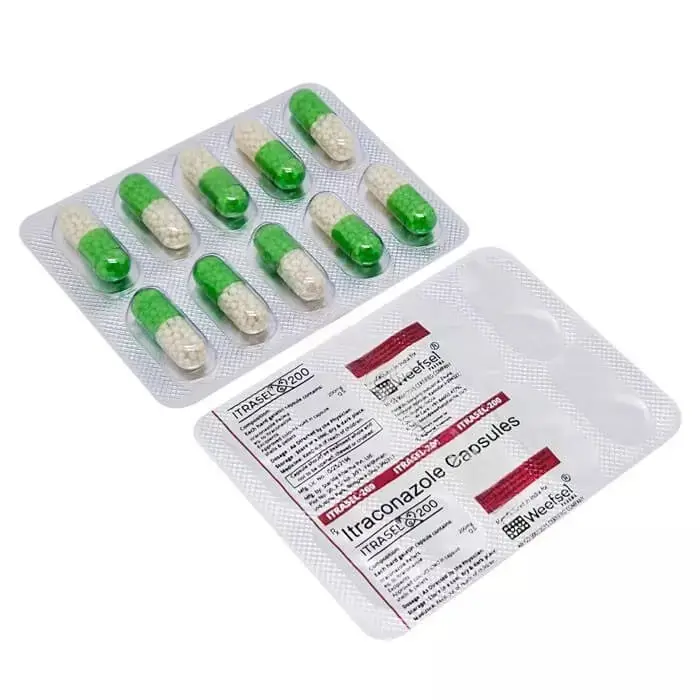
Itrasel 200mg (Itraconazole)
Previous product
Nixanide 500mg (Nitazoxanide)
A$20.00 A$58.00Price range: A$20.00 through A$58.00
Next product

KZ Cream (Ketoconazole)
A$21.25 A$81.25Price range: A$21.25 through A$81.25
A$82.50 A$205.00Price range: A$82.50 through A$205.00
Out of Stock
Out of Stock
Itrasel 200mg (Itraconazole)
| Pack Size | Price | Quantity | Add To Cart | |
|---|---|---|---|---|
| 60 Capsule/s | A$82.50 | |||
| 90 Capsule/s | A$102.50 | |||
| 120 Capsule/s | A$131.25 | |||
| 200 Capsule/s | A$205.00 | |||
| Want to order in bulk / B2B price? Send Inquiry | ||||
×
Sorry!! Out of Stock
Sorry! Itrasel 200mg (Itraconazole) is out of stock
Please click below to view other similar medications.
View All Itraconazole Products
Offer You Can't Resist
Free Shipping
Enjoy Free Shipping on Orders above AUD304 (USD199)
44
Fast service and great communication
Everything went exactly as expected. Fast service and great communication
 Australia
September 26, 2026
Last Updated on April 13, 2026

Description
Itrasel 200 mg (Itraconazole): Detailed Overview
Generic Name: Itraconazole
Brand Name: Itrasel
Drug Class: Azole Antifungal
What is Itraconazole?
Itraconazole is an all-encompassing antifungal azole that is employed for treating a range of fungal illnesses. It’s powerful against dermatophytes and yeasts as well as mold. It does this by inhibiting the synthesis of fungal cell membranes and thus halting the growth of fungal cells.
Mechanism of Action
Itraconazole hinders the enzyme of fungal origin, the lanosterol 14α-demethylase, which is one of the cytochrome P450 processes. The enzyme is responsible for the conversion of lanosterol into Ergosterol, which is a vital part of the fungal cell membrane.
- The inhibition of ergosterol synthesis can result in:
- Fungal cell membrane disruption Integrity
- The permeability of the membrane is increased
- Inhibited fungal cell growth and replication
Indications
Itraconazole is employed to treat many fungal diseases, such as:
- Onychomycosis (fungal nail infections)
- Dermatophytosis (ringworm, tinea infections)
- Candidiasis (oral thrush, esophageal candidiasis)
- Histoplasmosis
- Blastomycosis
- Aspergillosis (some cases)
- Fungal infections that are resistant to all other treatments
Dosage and Administration
- Standard dose: Most commonly, 200 mg is taken once each day. However, this dosage is able to be altered based on the type of infection and its severity.
- For onychomycosis: usually 200 mg at least every day for 6 to 12 weeks.
- Dosing and time of administration may vary. Sometimes, it’s best to start with an initial dose of.
- Taken in conjunction with food to improve absorption.
- Capsules/tablets must be swallowed completely by drinking a glass of water.
- Do not take an acid blocker, antacids, or proton pump inhibitors in the same order because they can reduce stomach acid and hinder absorption.
Pharmacokinetics
- Absorption: Variable. Enhanced when taken with food or in an acidic stomach atmosphere
- Bioavailability: Around 55% when combined with food
- Peak plasma concentration: 3 to 5 hours following oral dosage
- Protein binding: High (~99%)
- Half-life: ~24-42 hours (depending on dosing)
- Metabolism: Hepatic via CYP3A4
- Excretion: Mainly via feces
Side Effects
Common side effects:
- Gastrointestinal upset (nausea, vomiting, diarrhea)
- Headache
- Dizziness
- Rash or itching
Serious but rare side effects:
- Hepatotoxicity (Check for changes in liver function)
- Congestive heart failure (Exacerbation of predisposed patients)
- QT prolongation (Risk of arrhythmias)
- Allergic reactions (including Stevens-Johnson syndrome)
Contraindications
- Hypersensitivity to itraconazole as well as other antifungals containing azole
- Patients suffering from congestive heart failure or a history of heart failure (due to the negative effects of inotropics)
- The use of concurrently with certain drugs is not advised because of serious interactions (e.g., Cisapride, cisapride quinidine, etc).
Drug Interactions
Itraconazole is an effective inhibitor of the CYP3A4 enzyme that can cause a myriad of interactions between drugs:
- Statins (e.g., simvastatin) — increased risk of myopathy/rhabdomyolysis
- Benzodiazepines (e.g., midazolam) — increased sedation
- Calcium channel blockers — risk of hypotension and edema
- Warfarin — enhanced anticoagulant effects; track INR
- Digoxin — Higher levels, be sure to monitor them carefully
- Rifampin, carbamazepine, phenytoin — lower levels of itraconazole (avoid or check)
- Antacids, H2 blockers, PPIs — reduce itraconazole absorption
Precautions
- Take care when administering this medicine to patients with an impairment of the liver. Monitor your liver enzymes regularly.
- Be cautious when treating those with a heart condition.
- It is not recommended to use this method in the course of pregnancy unless the benefits outweigh the risks.
- Children are not extensively studied in this regard and are only used when clear indications are given.
Storage
- Keep in a dry, cool place far from direct sunlight.
- Make sure that the area is safe for young children.
Summary Table
| Feature | Details |
| Drug Name | Itraconazole (Itrasel) |
| Drug Class | Azole antifungal |
| Indications | Onychomycosis, dermatophytosis, candidiasis, systemic fungal infections |
| Dosage | 200 mg once daily (adjust per infection) |
| Route | Oral |
| Side Effects | GI upset, headache, hepatotoxicity, heart failure risk |
| Contraindications | Heart failure, hypersensitivity |
| Metabolism | Hepatic CYP3A4 |
| Major Interactions | Statins, warfarin, benzodiazepines, many others |
| Monitoring | Liver function, cardiac status, drug levels if needed |
Related products
Reviews
There are no reviews yet.