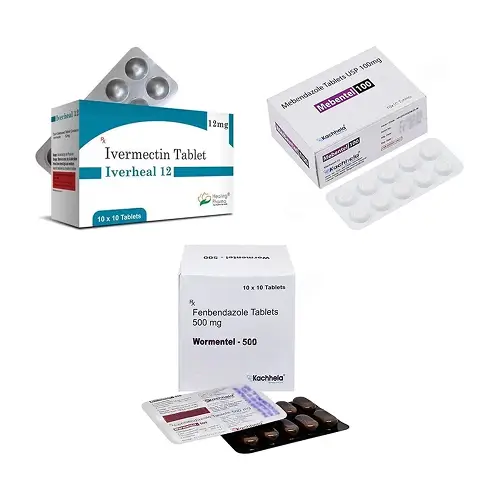
Fenbendazole 500+Mebendazole 100+Ivermectin 12
Previous product
Fenbendazole 500+Mebendazole 100+Ivermectin 6
$113.00 $329.00Price range: $113.00 through $329.00
Next product
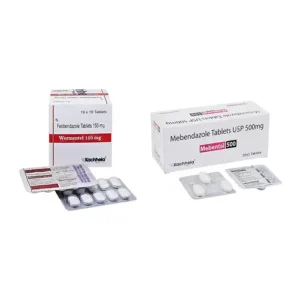
Fenbendazole 444+Mebendazole 500+Ivermectin 3
$119.00 $347.00Price range: $119.00 through $347.00
$125.00 $365.00Price range: $125.00 through $365.00
In Stock
In Stock
Fenbendazole 500+Mebendazole 100+Ivermectin 12
| Pack Size | Price | Quantity | Add To Cart | |
|---|---|---|---|---|
| 1 Pack | $125.00 | |||
| 2 Pack/s | $244.00 | |||
| 3 Pack/s | $365.00 | |||
| Want to order in bulk / B2B price? Send Inquiry | ||||
Offer You Can't Resist
Free Shipping
Enjoy Free Shipping on Orders above AUD304 (USD199)
Estimate Shipping :
07 June - 14 June
43
Professional service
Professional service from start to finish. Secure packaging, authentic products, and excellent customer care.
 Australia
May 28, 2026
Last Updated on March 07, 2026

Description
The prevalence of parasites remains a major problem for health worldwide, and affects millions of humans and animals each year. A well-designed treatment strategy is essential in preventing and eliminating these diseases, and the use of antiparasitic medications such as Mebendazole, Fenbendazole, and Ivermectin is frequently used because of their broad-spectrum effects.
In this post, we’ll look at the functions of Fenbendazole 500 mg, Mebendazole 100 mg, and Ivermectin 12 mg – how they function and what they are, the indications for them, the benefits of using combination therapy, health concerns, as well as frequently requested questions that will help you to better comprehend these drugs.
What Are Fenbendazole, Mebendazole, and Ivermectin?
Fenbendazole 500 mg
Fenbendazole falls under the benzimidazole family of antiparasitic medicines. It alters the metabolism of energy of parasite worms through binding to beta-tubulin and hindering the development of microtubules, which are essential for their cell activities. It causes the parasite’s demise.
Although fenbendazole is mostly used as a veterinary medicine treatment for intestinal parasites like hookworms, roundworms, whipworms, and some tapeworms, it’s also been studied in non-pharmacological settings for use in humans.
Mebendazole 100 mg
Mebendazole, which is also a benzimidazole that works by preventing the development of microtubules in parasites, efficiently starves them to death and killing the parasites. It’s the most commonly used treatment for intestinal helminths. It includes roundworms and pinworms, as well as whipworms and hookworms.
Mebendazole 100 mg can be an everyday dose employed in the treatment of the conditions and is frequently chosen due to its safety and effectiveness.
Ivermectin 12 mg
Ivermectin is an antiparasitic macrocyclic lactone that has a distinct method of action compared to benzimidazoles. It acts by binding to glutamate-gated chromium channels within muscle and nerve cells of parasites. It causes greater permeability to chloride ions and hyperpolarization. It also causes paralysis and the death of parasites.
It’s effective against a vast array of parasites, such as Nematodes (roundworms) and ectoparasites, like scabies mites and lice.
Why Combine Fenbendazole 500 + Mebendazole 100 + Ivermectin 12?
Combination therapy is usually contemplated when different kinds of parasites are suspected or proven to be present, or when monotherapy hasn’t been successful. Below are some of the reasons behind the combination of these three medicines:
- Broader spectrum: Every drug is targeted at slightly different types of parasites, or stages. Combining them will cover a larger variety of parasites and worms.
- Preventing resistance: Utilizing multiple medications with various mechanisms can lower the chance of parasites becoming resistant.
- Improved efficacy: Some parasites are more sensitive to a particular drug than one. Combination therapies can improve the overall clearance of parasites.
- Mixed infections: In areas with endemic disease where patients are found, they often suffer from multi-parasite infections that require extensive treatment coverage.
Common Uses of This Combination
- Treatment for gastrointestinal helminthic diseases such as roundworms, whipworms, hookworms, and pinworms.
- Treatment of ectoparasitic conditions like lice and scabies.
- The cases in which mixed or resistant parasites are thought to be the cause.
- Applications for veterinary use (primarily the use of fenbendazole as well as ivermectin) to fight parasites in animals.
How Do These Drugs Work Together?
- Fenbendazole and Mebendazole are synergistic in the form of benzimidazoles to interfere with the formation of microtubules and starve the worms, inhibiting the absorption of nutrients.
- Ivermectin is a neoplastic agent that attacks the nerve system affected by parasites through an alternative pathway that can cause paralysis of the patient and even death.
The combo fights infections on several fronts, which increases the odds of eradicating stubborn diseases.
Dosage and Administration
Important: The dosage is based on the weight of the patient, their type of illness, and the recommendations for clinical practice. Always adhere to the prescribed dosage as well as the advice of a healthcare physician.
- Fenbendazole: Most commonly, it is given in the form of 500 mg every day for several days (exact length is different).
- Mebendazole: A common dose is 100 mg twice a day for three days, or one 100 mg dosage for certain diseases.
- Ivermectin: The standard dosage is 12 mg in one dose. It is sometimes repeated every 2 or 3 weeks, based on the severity of the disease.
Safety and Side Effects
If taken according to the prescription, these medications are generally well-tolerated. Some side effects may occur:
Common Side Effects
- Fenbendazole: Mild gastrointestinal upset (nausea, vomiting), rare allergic reactions.
- Mebendazole: Abdominal pain, diarrhea, headache, dizziness.
- Ivermectin: Itching, rash, dizziness, mild swelling, and rarely neurological symptoms.
Precautions
- It is not recommended for pregnant women unless it is clearly stated by a doctor.
- Take care when using this medication in patients who have renal or liver impairment.
- Any potential drug interactions must be investigated by a health expert.
- Hypersensitivity or allergic reactions to any ingredient must be reported promptly.
FAQ: Fenbendazole 500 + Mebendazole 100 + Ivermectin 12
Q1: Can I take these three drugs together without consulting a doctor?
A: No. The combination therapy must always be monitored by a medical specialist to ensure the correct dosage as well as safety.
Q2: What infections does this combination treat?
A: The combination works against a variety of intestinal parasites (roundworms whipworms, hookworms, and pinworms) and some external parasites such as lice and scabies mites.
Q3: Are these drugs safe for children?
A: They are generally safe for young children. However, dosage is dependent on weight and must be monitored by a pediatrician.
Q4: How soon will I see improvement after starting treatment?
A: The symptoms typically improve over the course of a few days. However, full removal may take a bit longer. A follow-up appointment may be required for confirmation of the eradication.
Q5: Can these medications cause resistance?
A: The misuse and abuse of drugs to treat parasites can cause resistance. Use them only as directed.
Q6: Can I take these medications if I am pregnant or breastfeeding?
A: The use of these drugs is generally not suggested during the period of pregnancy or while breastfeeding unless advised otherwise by a doctor.
Q7: Are these medications available over the counter?
A: The availability of prescriptions varies according to region and regulations. A prescription is needed.
Conclusion
Fenbendazole 500 mg, Mebendazole 100 mg, and Ivermectin 12 mg are a potent combination that can fight off an array of parasite diseases. Their synergistic mechanisms aid in achieving better outcomes for resistance or mixed infection. But their use must be guided by a medical specialist to ensure the security and effectiveness.
Additional Information
| Manufacturer | Healing Pharma, India, Kachhela Medex Pvt.Ltd |
|---|---|
| Pharmaceutical | Tablet/s |
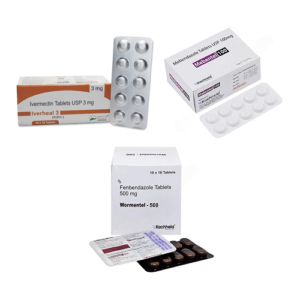
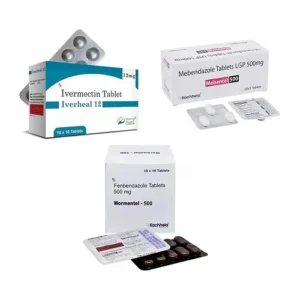
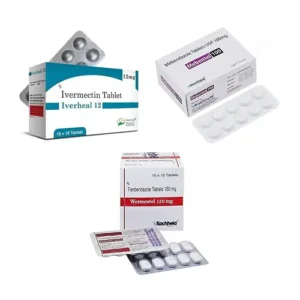
| Tablet/s | Wormentel 500mg (Fenbendazole) = 60 Pills, Mebentel 100mg (Mebendazole) = 60 Pills, Iverheal 12mg (ivermectin) = 60 Pills |
Related products

Recently Viewed