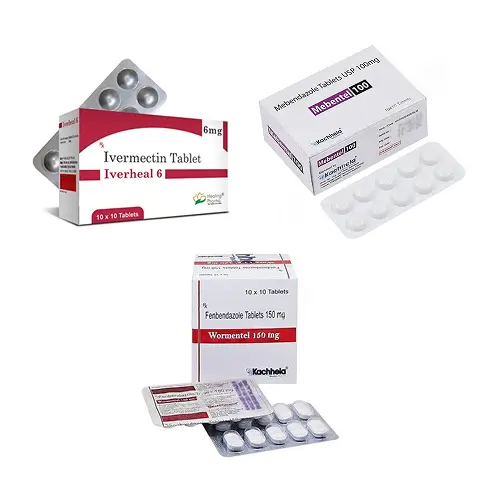
Fenbendazole 150+Mebendazole 100+Ivermectin 6
Previous product
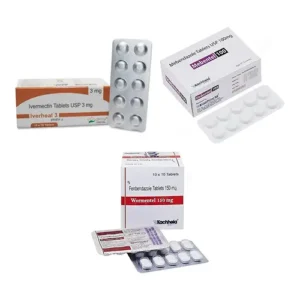
Fenbendazole 150+Mebendazole 100+Ivermectin 3
$91.00 $263.00Price range: $91.00 through $263.00
Next product
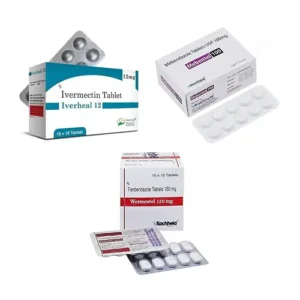
Fenbendazole 150+Mebendazole 100+Ivermectin 12
$109.00 $317.00Price range: $109.00 through $317.00
$97.00 $281.00Price range: $97.00 through $281.00
In Stock
In Stock
Fenbendazole 150+Mebendazole 100+Ivermectin 6
| Pack Size | Price | Quantity | Add To Cart | |
|---|---|---|---|---|
| 1 Pack | $97.00 | |||
| 2 Pack/s | $188.00 | |||
| 3 Pack/s | $281.00 | |||
| Want to order in bulk / B2B price? Send Inquiry | ||||
×
Sorry!! Out of Stock
Sorry! Fenbendazole 150+Mebendazole 100+Ivermectin 6 is out of stock
Please click below to view other similar medications.
View All Fenbendazole Products
Offer You Can't Resist
Free Shipping
Enjoy Free Shipping on Orders above AUD304 (USD199)
Estimate Shipping :
08 June - 15 June
30
Excellent service
Excellent service! My order was processed quickly and delivered on time. The medicines were well-packaged and exactly as described. Highly recommended.
 Australia
May 26, 2026
Last Updated on February 25, 2026

Description
Overview
The formula for this veterinary grade formulation contains three powerful antiparasitic ingredients: Fenbendazole (150mg), Mebendazole (100mg), and Ivermectin (6mg)–to deliver the broad spectrum of control for parasites within one dose.
Utilized across many animals, this triple-action formulation is created to get rid of intestinal worms, migratory larvae, lungworms and bots, mites, and parasites, which makes it an effective cure for multi-parasite infections or for deworming strategies for livestock and domestic environments.
Veterinarians from Australia typically depend on this combo for the range of options, its reliability, and its capability to handle resistance with multi-targeted action.
What This Combination Does
Every component in this mix performs differently:
- Fenbendazole (150mg): A benzimidazole which disrupts the energy metabolism of parasites by eliminating hookworms and roundworms, as well as whipworms, and some tapeworms.
- Mebendazole (100mg): Another benzimidazole that binds to parasite microtubules, interfering with glucose absorption and reproduction—effective against nematodes and some cestodes.
- Ivermectin (6mg): A macrocyclic lactone that disables and kills parasites through targeting muscles and nerve functions. Particularly effective against parasites from outside and tissue-dwelling stages.
Together, they offer complete parasite elimination and treatment for even the most difficult diseases.
Common Veterinary Uses
The medication is given by veterinary doctors for the treatment or control of:
- Gastrointestinal roundworms (e.g. Toxocara, Ancylostoma, Ascaris)
- Hookworms and whipworms
- Tapeworm species (partially effective)
- Lungworms
- Threadworms (Strongyloides)
- Bots (in horses)
- Mites causing mange (e.g. Sarcoptes, Demodex)
- Ectoparasitic infestations such as lice or burrowing mites
This broad-based efficacy is ideal to use for rotating deworming, pasture management, as well as the treatment of animals suffering from large parasite burdens.
Dosage and Administration
| Animal Species | Typical Dose* | Route | Frequency | Notes |
| Dogs | 1 tablet per 10–15kg body weight | Oral | Single dose or as directed | Herding breeds could be more sensitive to Ivermectin. Take care. |
| Cats | Vet discretion only | Oral | Weight-specific | Some cats are not tolerant of Ivermectin. Be sure to watch them closely. |
| Cattle | Based on weight (per 150–200kg) | Oral/bolus | As needed or seasonal | Be aware of the withdrawal time if you are using milk or meat. |
| Goats/Sheep | Vet-supervised dosage | Oral | Periodic | Most often, it is used without a label. |
| Horses | Adjusted per 100kg body weight | Oral | 3–4 times/year | Utilize in conjunction with dewormers that have other functions to decrease resistance. |
* The exact dosage and frequency should be analyzed by a vet.
Do not take self-dosing or make a guess based on your own or other medications for animals.
Benefits of Triple Action
- It covers a broad spectrum of parasites, all in one dosage
- Reducing the need to take multiple medicines
- Effective in severe or mixed infestations
- Reduces resistance by utilizing multiple mechanisms
- It is suitable for a strategic control of parasites at kennels, farms, as well as shelters
- It targets both adults and the larval stage of parasites
Safety Advice
- Always dosing according to the body mass of your animal and the species.
- Not advised for pregnant women, young, or lactating animal unless a prescription is given
- Avoid it when you are using Collies, Australian Shepherds, Shelties, and other breeds carrying the MDR1 mutations.
- Avoid using it concurrently with other dewormers, unless you are directed to do so.
- Beware of use in sick or immunocompromised pets without Vet clearance
Possible signs of a negative reaction or an overdose:
- Drooling, vomiting, or diarrhoea
- Weakness or lack of coordination
- Muscle tremors
- Seizures (rare, often Ivermectin-related)
- Sudden lethargy after dose
Contact your veterinarian if you observe concerning symptoms.
Possible Side Effects
A majority of animals are able to tolerate this mix quite well, especially when administered correctly. But, adverse reactions can be experienced, particularly during the first time of usage or during high levels of parasite death.
Mild and common:
- Diarrhoea or soft stool
- Acute fatigue, or temporary fatigue
- Mild itchiness as mites die off
Rare or serious:
- Acute neurological signs (staggering or confusion)
- Hypersensitivity to the antigens of parasites
- Seizures (primarily caused by Ivermectin, a chemical in the sensitive breeds)
The following veterinary check-up is recommended following the initial treatment for cases of severe infections.
Storage Instructions
- Keep it in a dry, cool place
- Guard against moisture and light
- Stay away from children as well as the other animals
- Use only the product that is not expired
- Consult your local vet or regulations regarding disposal
Summary Chart
| Feature | Description |
| Active Ingredients | Fenbendazole 150mg, Mebendazole 100mg, Ivermectin 6mg |
| Class | Anthelmintic, macrocyclic lactone |
| Primary Use | Broad-spectrum parasite control |
| Target Parasites | Worms, mites, bots, migrating larvae |
| Administration Route | Oral tablet |
| Suitable for | Dogs, cats*, cattle, goats, horses (*vet-guided) |
| Prescription Required | Usually yes (Australia) |
| Onset of Action | Within 24–48 hours |
| Duration of Effect | 2–4 weeks (may vary by parasite load) |
Frequently Asked Questions
- What is this combination used for?
It can treat a range of external and internal parasites like whipworms, roundworms, bots, and mites animals. - Can I use this on all animals?
No. It has to be specific to the species and dose-specific. Certain species of animals, such as cats and herding dogs, might react negatively to Ivermectin. Always seek advice from a veterinarian. - Why use all three ingredients together?
Every ingredient is targeted at different types of parasites, or life stages, which makes it a great choice for mixed infestations as well as for rotational dewormer. - Is it safe for puppies or kittens?
It’s not usually. Young animals are more tolerant of medications that treat parasites. Veterinarians may recommend alternatives based on weight and age. - How often should I use this for dogs?
It depends on the degree of exposure to parasites as well as the location and risks. Deworming procedures typically apply the process every 3-6 months in conjunction with a veterinarian. - Will it kill tapeworms?
It’s effective in part against specific varieties (e.g., Taenia), but not Dipylidium. In order to cover the entire tapeworm, an item containing Praziquantel could be necessary. - Can it prevent heartworm?
Ivermectin is a heartworm-preventative for larvae; however, this is not a substitute for the daily heartworm prevention. - Is resistance a concern with this combo?
Multi-agents reduce the likelihood of resistance. However, the use of a responsible method is essential. Make sure to rotate dewormers and adhere to vet-advised timetables. - What if I miss a dose?
Take it as soon as you can remember it, unless you are nearing the next dose. Do not double-dose without the advice of your vet. - Do I need to worm other pets in the household too?
Yes. They can be easily spread, which is why any animal that comes into contact with them needs to be examined and treated in order to avoid reinfection.
Final Thoughts
Fenbendazole 150mg + Mebendazole 100mg + Ivermectin 6mg is an effective multi-purpose solution to broad pest control in veterinary environments. The product is active against intestinal internal worms, external mites, the larvae, and bots is ideal to control multiple infestations as well as targeted control plans in shelters, farms, or in families with multiple animal species.
Consult your veterinarian prior to using, particularly with breeds or species with a high risk of sensitivity, as well as follow-up by maintaining a clean environment in order to lower the possibility of re-infection.
Additional Information
| Manufacturer | Healing Pharma, India, Kachhela Medex Pvt.Ltd |
|---|---|
| Pharmaceutical | Tablet/s |
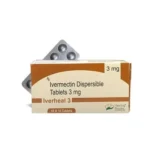
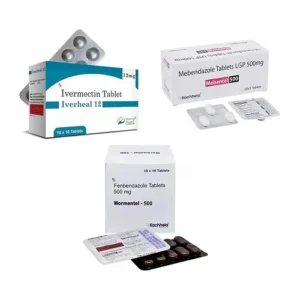
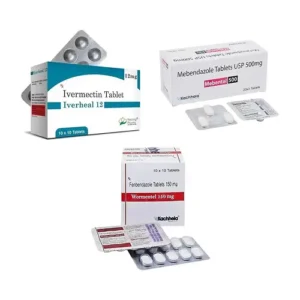
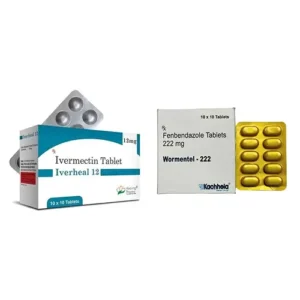
| Tablet/s | Wormentel 150mg (Fenbendazole) = 60 Pills, Mebentel 100mg (Mebendazole) = 60 Pills, Iverheal 6mg (ivermectin) = 60 Pills |
Related products
Recently Viewed