
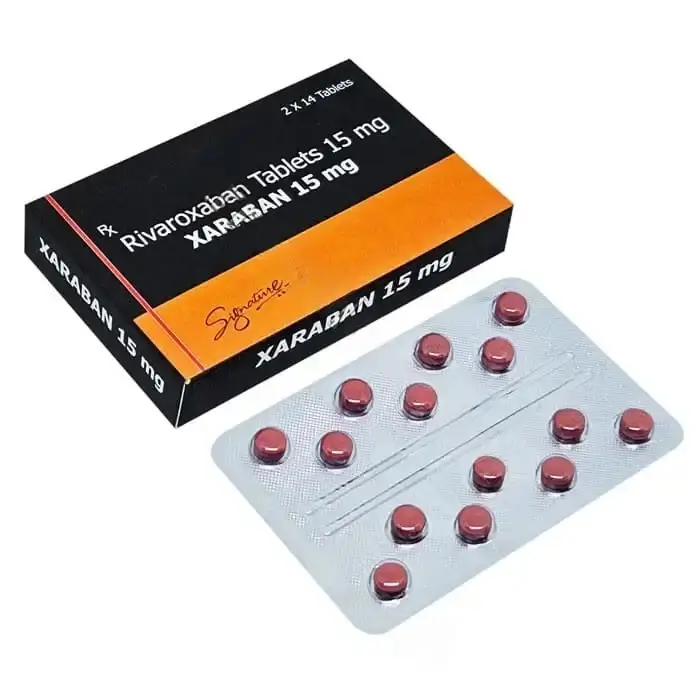
Xaraban (Rivaroxaban)
Previous product
Dermozole 500mg (Griseofulvin)
A$35.10 A$63.17Price range: A$35.10 through A$63.17
Next product
Twinaqt (Dolutegravir/Lamivudine)
A$109.50 A$252.68Price range: A$109.50 through A$252.68
A$63.17 A$161.44Price range: A$63.17 through A$161.44
In Stock
In Stock
Xaraban (Rivaroxaban)
| Pack Size | Price | Quantity | Add To Cart | |
|---|---|---|---|---|
| 28 Tablet/s | A$63.17 | |||
| 56 Tablet/s | A$112.30 | |||
| 84 Tablet/s | A$161.44 | |||
| Want to order in bulk / B2B price? Send Inquiry | ||||
×
Sorry!! Out of Stock
Sorry! Xaraban (Rivaroxaban) is out of stock
Please click below to view other similar medications.
View All Rivaroxaban Products
Offer You Can't Resist
Free Shipping
Enjoy Free Shipping on Orders above AUD304 (USD199)
Estimate Delivery :
19 October - 26 October
40
Excellent service overall
Smooth checkout, quick dispatch, and secure delivery. Excellent service overall
 Australia
October 1, 2026
Last Updated on June 29, 2026

Description
Product Overview
Xaraban is a brand of Rivaroxaban, an extremely efficient oral anticoagulant medicine, which is prescribed to treat and prevent blood clots. It’s part of a group of drugs known as Direct Oral Anticoagulants (DOACs) or Factor Xa inhibitors. It is an alternative to conventional blood thinners, such as warfarin. Offering predictable anticoagulation, with fewer interactions with food or drugs and no requirement for frequent blood tests of blood in the majority of situations.
Rivaroxaban is frequently prescribed to treat diverse thromboembolic diseases, and can reduce the chance of suffering from stroke, systemic embolism, as well as deep vein thrombosis (DVT) or an embolism in the pulmonary tract (PE).
Active Ingredient
- Rivaroxaban — They are available in doses that range in size from 2.5 mg to 20 mg in a tablet, based on the prescription
Indications
Xaraban (Rivaroxaban) is indicated for:
- The prevention of strokes and embolism in patients suffering from non-valvular atrial fibrillation.
- Treatment and secondary prevention of deep vein thrombosis (DVT) and pulmonary embolism (PE)
- Prevention of venous blood thromboembolism (VTE) in patients receiving hip or knee replacement surgery.
- Preventing atherothrombotic incidents in people suffering from chronic coronary arterial disease (CAD) or peripheral arterial disease (PAD)
Mechanism of Action
Rivaroxaban is a targeted, direct inhibit on Factor Xa, which is an important enzyme of the blood coagulation chain. Inhibiting Factor Xa and preventing the conversion of prothrombin into thrombin, thus reducing the development of fibrin blood clots.
Contrary to warfarin, which alters several factors that cause clotting and demands surveillance, Rivaroxaban targets Factor Xa specifically. It provides a fast start of action as well as predictable anticoagulation.
Dosage and Administration
Dosage can vary based on the nature of the indication and characteristics of the patient. Common dosing regimens include:
- Non-valvular atrial fibrillation: 20 mg a day, along with food. 15 mg a day when kidney function is compromised (creatinine clearance of 15-50mL/min)
- Treatment of DVT and PE: 15 mg two times a day, in combination with food for the initial 21 days. This is followed by 20 mg a day
- Prevention of VTE after orthopedic surgery: 10 mg once a day, beginning 6-10 hours after surgery for 12-35 days, based on the type of surgery.
- Secondary prevention of recurrent VTE: 10 mg a day after at least six months of treatment
- Prevention of atherothrombotic events in CAD/PAD: 2.5 mg daily, when combined with aspirin at a low dose
Administration: Xaraban tablets must be consumed by mouth, along with food, to improve absorption, particularly at doses of 15 mg and higher.
Pharmacokinetics
- Absorption: Absorbs quickly and has the highest plasma concentrations in 2-4 hours
- Bioavailability: About 80-100% when used along with food in doses as high as 10 mg
- Metabolism: The liver is transformed into a metabolic state through CYP3A4/5 as well as CYP2J2 enzymes
- Elimination: About two-thirds of the metabolites are eliminated through fecal and renal routes 1/3 of the excreted remains unchanged through the urine
- Half-life: 5-9 hours for young adults. 11-13 hours for the elderly
Benefits of Xaraban
- Predictable anticoagulation — There is no need for routine monitoring generally
- Quick start as well as offset of treatment for fast anticoagulation treatment
- A lower risk of bleeding-related complications when compared with warfarin, especially intracranial hemorrhage
- Dosing orally is convenient every day, either once or twice, without food restrictions
- Lower interactions with drugs than anticoagulants, which are more traditional
- It is effective for a wide spectrum of thromboembolic diseases
Side Effects
Common side effects:
- Bleeding (e.g., nosebleeds, bruising)
- Anemia
- Gastrointestinal upset (nausea, indigestion)
Serious side effects:
- Major bleeding (gastrointestinal, intracranial, or other)
- Hypersensitivity reactions (rash, itching, swelling)
- Liver enzyme elevations (rare)
If you experience abnormal bleeding or symptoms of a severe allergic reaction, get medical help immediately.
Contraindications
Xaraban should not be used in:
- Active pathological bleeding
- Hypersensitivity severe to rivaroxaban, or any of the tablet components
- Patients with a severe liver condition that is coagulopathy-related and at risk of bleeding
- Patients who have prosthetic valves (safety not proven)
- Patients suffering from severe impairment of the kidney (creatinine clearance <15 mL/min) or who are on dialysis
Precautions
- Examine bleeding risk before beginning Xaraban. Avoid areas of high-risk bleeding, unless benefits exceed risks
- Be cautious in patients who have impaired liver or kidney function
- Avoid abruptly stopping Xaraban without consulting a health doctor, since this can increase the chance of developing thrombotic issues.
- All healthcare professionals and dentists should receive Xaraban treatment before undergoing any procedure.
- Beware of concomitant use with any other anticoagulants, unless advised otherwise.
- The pregnancy category is typically “not advised” unless there are benefits that outweigh the potential risks
Drug Interactions
- Increase bleeding risk with:
- Other anticoagulants or antiplatelet drugs (e.g., aspirin, clopidogrel)
- NSAIDs
- Certain SSRIs/SNRIs
- Drugs that increase rivaroxaban levels (may increase bleeding risk):
- Strong CYP3A4 and P-gp inhibitors like ketoconazole, ritonavir, clarithromycin
- Drugs that decrease rivaroxaban levels (may reduce efficacy):
- Rifampin, carbamazepine, phenytoin, St. John’s Wort
Make sure you inform your doctor of the medications and supplements that you consume.
Use During Pregnancy and Breastfeeding
- The safety of pregnancy hasn’t been confirmed; however, it is recommended to avoid pregnancy except when clearly needed
- Rivaroxaban is excreted in breastmilk; breastfeeding is usually not advised when undergoing treatment.
Storage
- Store Xaraban tablets at room temperature (15–30°C)
- Store in original packaging to keep moisture out
- Make sure that the items are out of Children’s reach
Patient Counseling Information
- Do not take Xaraban exactly as it is prescribed and eat food in doses of ≥15 mg
- Avoid missing doses. Do not miss doses and take them as soon as you remember them, unless it is near the time of your next dose
- Beware of activities that can may increase the risk of bleeding (e.g., contact sports)
- Inform us of any bleeding or bruising immediately.
- Inform your healthcare provider of Xaraban treatment before surgical or dental procedures.
- Do not begin or stop taking any medicine without consulting your physician
Summary Table
| Parameter | Details |
| Generic Name | Rivaroxaban |
| Brand Name | Xaraban |
| Drug Class | Direct Factor Xa Inhibitor (DOAC) |
| Dosage Forms | Oral tablets (2.5 mg, 10 mg, 15 mg, 20 mg) |
| Indications | Stroke prevention in AF, DVT/PE treatment & prevention, VTE prophylaxis after surgery, CAD/PAD prevention |
| Administration | Oral, once or twice daily, with food for doses ≥15 mg |
| Mechanism of Action | Selective, direct Factor Xa inhibition |
| Monitoring | The routine monitoring of coagulation usually isn’t needed |
| Contraindications | Active bleeding, severe liver disease, prosthetic valves |
| Common Side Effects | Bleeding, anemia, GI upset |
| Major Risks | Major bleeding, hypersensitivity |
| Storage | Room temperature, dry place |
Conclusion
Xaraban (Rivaroxaban) provides an innovative, efficient, and cost-effective choice for treatment of anticoagulation that can be used across a range of thromboembolic disorders. The predictable actions and ease of oral doses, as well as a lower requirement for monitoring, are highly appropriate for a variety of patients when compared with older anticoagulants.
Yet, appropriate patient selection along with adherence to the treatment and understanding of the risks associated with bleeding are essential for safe and efficient use. Be sure to use Xaraban under the supervision of a physician and immediately report any symptoms that are unusual.
Related products

Reviews
There are no reviews yet.