
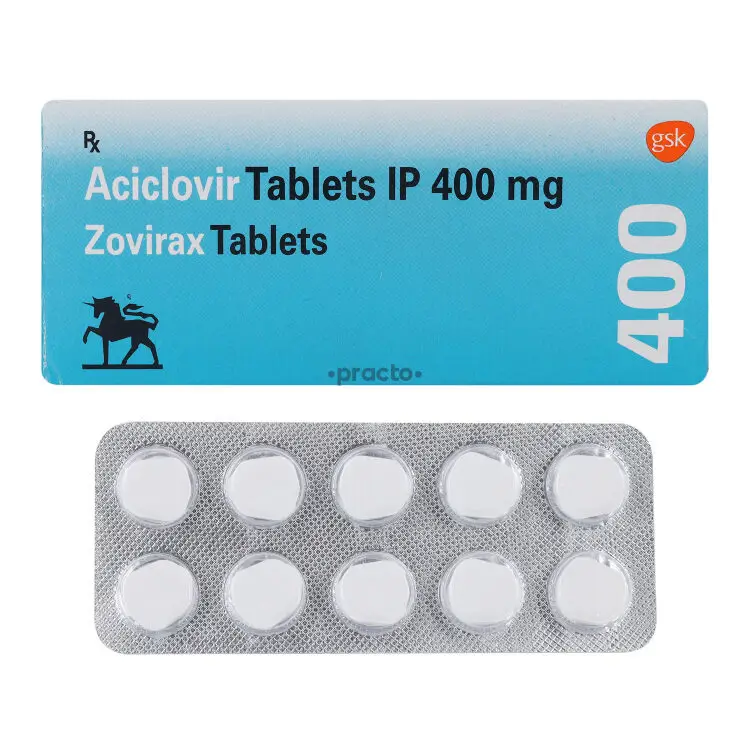
Zovirax 400mg (Acyclovir)
Previous product

Zovirax 200mg (Acyclovir)
$14.00 $39.00Price range: $14.00 through $39.00
Next product
Zovirax 800mg (Acyclovir)
$40.00 $115.00Price range: $40.00 through $115.00
$24.00 $65.00Price range: $24.00 through $65.00
In Stock
In Stock
Zovirax 400mg (Acyclovir)
| Pack Size | Price | Quantity | Add To Cart | |
|---|---|---|---|---|
| 30 Tablet/s | $24.00 | |||
| 60 Tablet/s | $46.00 | |||
| 90 Tablet/s | $65.00 | |||
| Want to order in bulk / B2B price? Send Inquiry | ||||
×
Sorry!! Out of Stock
Sorry! Zovirax 400mg (Acyclovir) is out of stock
Please click below to view other similar medications.
View All Acyclovir Products

Offer You Can't Resist
Free Shipping
Enjoy Free Shipping on Orders above AUD304 (USD199)
Estimate Shipping :
29 August - 05 September
41
Last Updated on July 02, 2026
✔
Medically Reviewed By
 Dr. Brandon Wallace, MD, FAAD – Dermatologist / Infectious Disease Specialist
Dr. Brandon Wallace, MD, FAAD – Dermatologist / Infectious Disease Specialist
Description
Zovirax 400mg (Acyclovir) – Product Information
Product Name: Zovirax 400mg
Active Ingredient: Acyclovir 400 mg
Drug Class: Antiviral agent (Nucleoside analogue)
Dosage Form: Tablet, 400 mg
Overview
Zovirax 400mg contains Acyclovir, an antiviral synthetic nucleoside medicine that is used to treat ailments that are caused by the herpesvirus family. This includes herpes simplex virus varieties 1 and 2 (HSV-1 and HSV-2) and varicella-zoster viruses (VZV), as well as other related viral diseases.
Acyclovir is a drug that blocks viral DNA synthesis, stopping viral replication and thus decreasing the duration and severity of infections caused by viruses. It’s effective for combating active infections as well as sometimes to stop recurring flares.
Therapeutic Indications
Zovirax 400mg is indicated for:
- Herpes Simplex Virus Infections
- Initial and recurrent episodes of genital herpes (HSV-2)
- Herpes labialis (cold sores caused by HSV-1)
- Herpes simplex encephalitis
- Infections with mucocutaneous herpes simplex in patients with immunocompromised immune systems
- Varicella-Zoster Virus Infections
- Treatment of shingles (herpes zoster)
- Chickenpox (varicella) is a common occurrence, especially for immunocompromised patients, or in the most severe of instances
- Prophylaxis
- Recurrent herpes genitalis is suppressed in immunocompetent patients
- Preventing cytomegalovirus-related infections among transplant recipients (off-label treatment)
Mechanism of Action
Acyclovir is a guanosine-based analogue that specifically targets the replication of DNA in viral cells. In the cells infected, the acyclovir molecule is phosphorylated by the thymidine kinase of viral thymidine to create monophosphate. Host enzymes transform it into acyclovir triphosphate, the active form that is a powerful inhibitor of the DNA polymerase of viral origin.
The process causes rapid ending of DNA chains that carry viral DNA, preventing viral replication, with little effect on the host cell.
Pharmacokinetics
- Absorption: The bioavailability for oral intake is around 15-30%; eating food doesn’t alter absorption in any significant way.
- Peak Plasma Concentration: It is achieved within 1.5 to 2 hours following oral administration.
- Distribution: The body’s tissues are widely distributed, as well as fluids, such as cerebrospinal fluid.
- Metabolism: Hepatic metabolism is minimal.
- Elimination: Mostly excreted unaltered by the kidneys.
- Half-Life: About 2.5 or 3.3 hours for patients with normal renal function. It can be prolonged with kidney impairment.
Dosage and Administration
Adults:
- Herpes simplex (genital and mucocutaneous):
200 mg taken orally every four hours, 5 times daily over 10 days (total 1g per day). Or 400 mg three times a day for 7 to 10 consecutive days. - Herpes zoster (shingles):
800 mg taken orally five times per day for a period of 7 to 10 days. - Chickenpox:
800 mg taken orally four times a day for five days. - Suppression of recurrent genital herpes:
400 mg twice a day orally.
Pediatric Use:
- Dosage is determined by weight and modified according to the severity of infection as well as clinical guidelines.
Renal Impairment:
- Adjusting dosage is necessary in those with impaired kidney function to reduce the accumulation of the drug.
Contraindications
- Hypersensitivity is known to acyclovir and Valacyclovir.
- Be cautious when you have patients with a known serious renal impairment, and without dosage adjustment.
- Do not use in patients who have had serious adverse reactions to Acyclovir.
Warnings and Precautions
- Renal Function Monitoring
Acyclovir is excreted mainly by the kidneys. Patients, in particular people over the age of 65 or with impaired renal function, must have their monitoring of renal function monitored. Adjustments to dosages may be required in order to reduce the risk of the development of toxicity.
- Neurological Effects
Sometimes, excessive doses or levels can result in neurological adverse consequences such as anxiety, hallucinations, confusion, tremors, or seizures, particularly in those with kidney impairment.
- Hydration
A proper hydration regimen is advised in order to minimize the chance of developing crystalluria or kidney damage.
- Pregnancy and Lactation
Acyclovir is classified as Pregnancy category B (no evidence of human risk). Pregnancy-related use should be guided by clinical judgement. Be cautious when breastfeeding.
Adverse Effects
Common side effects:
- Nausea and vomiting
- Diarrhea
- Headache
- Fatigue
Less common but serious adverse effects:
- Renal toxicity, including acute renal failure
- Neurotoxicity (confusion, hallucinations)
- Allergic reactions (rash, itching, anaphylaxis)
- Blood disorders (rare cases of neutropenia or thrombocytopenia)
It is recommended that patients notify any symptoms that are unusual promptly.
Drug Interactions
- Probenecid: Reduce renal clearance for Acyclovir and increase plasma levels.
- Other nephrotoxic agents: Use in conjunction with other drugs such as aminoglycosides and cyclosporine, can increase the risk of kidney toxicities.
- Live vaccines: Antivirals that suppress immunity can cause interference with live virus vaccines.
Use in Special Populations
- Pregnant women: Make use of it only when clearly required. Benefits outweigh risk.
- Nursing mothers: Take care; acyclovir gets eliminated in breast milk.
- Pediatric patients: Dosage needs to be carefully modified based on weight and medical condition.
- Geriatric patients: Check renal function and dosage adjustments could be necessary.
Storage
- Keep at a temperature that is controlled, 20°C to 25°C (68°F to 77°F).
- Protect from moisture.
- Be sure to keep away from young children.
Packaging
- Available in blister packs of 10 tablets.
- Tablets are round, film-coated, imprinted with identification codes.
Frequently Asked Questions
Q: How soon after starting Zovirax will symptoms improve?
A: The signs usually disappear within 3 days after treatment commencement. However, it is crucial to follow the complete treatment to decrease infection and spread.
Q: Can Zovirax cure herpes infections?
A: No, acyclovir isn’t able to treat herpes, but it can reduce the intensity, duration, and frequency of outbreaks.
Q: Can I take Zovirax without food?
A: Yes, Zovirax may indeed be consumed in combination with or without food.
Q: What should I do if I miss a dose?
A: Do not miss a dose until immediately when you can remember it or if it’s close to the time of your next dose. Don’t double your dose.
Conclusion
Zovirax 400mg (Acyclovir) is a powerful antiviral medicine that is widely utilized for the control and treatment of herpes viral infection. The safety record of its proven effectiveness, its broad antiviral properties, and a range of dosage options make it ideal for short-term treatment as well as for long-term protection for recurrent infections.
The proper adherence to dosages and monitoring is a great way to improve the therapeutic outcome and reduce the negative side effects. Patients are advised to adhere to the instructions of their healthcare professional and to report any adverse effects immediately.
Additional Information
| Manufacturer | GlaxoSmithKline Pharmaceuticals Ltd |
|---|---|
| Pharmaceutical | Tablet/s |
| Strength | 400 mg |
| Pack Size | 30 Tablet/s, 60 Tablet/s, 90 Tablet/s |
Related products
Reviews
There are no reviews yet.