

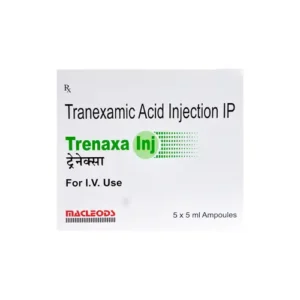
Trenaxa Injection (Tranexamic Acid)
Previous product
Symbicort Turbohaler 160mcg (Budesonide/Formoterol)
A$28.08 A$147.40Price range: A$28.08 through A$147.40
Next product

Peptilcer Iv (Pantoprazole)
A$1.40 A$8.42Price range: A$1.40 through A$8.42
A$19.65 A$70.19Price range: A$19.65 through A$70.19
In Stock
In Stock
Trenaxa Injection (Tranexamic Acid)
| Pack Size | Price | Quantity | Add To Cart | |
|---|---|---|---|---|
| 5 Injection/s | A$19.65 | |||
| 10 Injection/s | A$37.90 | |||
| 20 Injection/s | A$70.19 | |||
| Want to order in bulk / B2B price? Send Inquiry | ||||
×
Sorry!! Out of Stock
Sorry! Trenaxa Injection (Tranexamic Acid) is out of stock
Please click below to view other similar medications.
View All Tranexamic Acid Products

Offer You Can't Resist
Free Shipping
Enjoy Free Shipping on Orders above AUD304 (USD199)
Estimate Delivery :
25 October - 01 November
42
Great customer service
Great customer service and a straightforward ordering process. I’m very satisfied
 Australia
September 28, 2026
Last Updated on June 15, 2026

Description
Trenaxa Injection (Tranexamic Acid) – Product Information
Brand Name: Trenaxa Injection
Generic Name: Tranexamic Acid
Strength: 500 mg/5 ml or 1000 mg/10 ml (commonly available concentrations)
Dosage Form: Intravenous Injection
Therapeutic Class: Antifibrinolytic agent
Prescription Status: Rx only (Prescription Required)
Product Description
Trenaxa Injection is a drug that contains Tranexamic Acid, which is a synthetic derivative of the amino acid Lysine. It functions as an antifibrinolytic drug by blocking the release of plasminogen, the enzyme plasmin that reduces fibrin blood clots. This helps to reduce or stop excessive bleeding from many medical conditions, such as surgeries, trauma, and bleeding disorders of various kinds.
Tranexamic Acid is widely utilized in clinical settings because of its efficacy at reducing hemorrhage, without significantly enhancing the risk of thrombosis when used in carefully targeted patients.
Composition
The 5 ml ampoules made of Trenaxa Injection contain:
- Tranexamic Acid IP: 500 mg
- Water for Injection: q.s.
(Other formulations, for example, can be purchased in 10ml ampoules that contain 1,000 mg Tranexamic Acid.)
Mechanism of Action
Tranexamic Acid functions through reversible binding to the lysine receptors that are located on plasminogen and plasmin. This blocks the interplay between fibrin and plasminogen and prevents the dissolution of fibrin blood clots (fibrinolysis). It helps to stabilize clots that have formed and reduce bleeding, but without triggering the formation of clots.
Indications and Uses
Trenaxa Injections are indicated for treatment and prevention of excessive bleeding during various circumstances, including:
- Menorrhagia (heavy menstrual bleeding)
- Epistaxis (nosebleeds)
- Dental treatments for patients suffering from bleeding problems (e.g., hemophilia)
- Traumatic hyphema (bleeding in the eye)
- Postpartum hemorrhage (PPH)
- Bleeding during the procedure after surgeries with the highest chance of bleeding, such as:
- Cardiac surgery
- Orthopedic surgery (e.g., joint replacements)
- Liver transplantation
- Spinal surgery
- Trauma patients with significant hemorrhage
- Hereditary angioedema (off-label use)
- Prostate and bladder surgery
Dosage and Administration
Adults
- Typical IV dose: 10–15 mg/kg of body weight given 2-3 times per day at intervals of 8 hours.
- For surgery: 15 mg/kg before incision and then at intervals of 8 hours until 24 hours after the operation or according to the physician’s recommendation.
- In trauma or severe bleeding: One loading dose in the form of 1 g IV spread over 10 minutes, and then which is followed by constant infusion (e.g., 1 g spread over 8 hours), could be administered.
Pediatrics
- Dosing needs to be tailored and should be based on weight and the clinical indication. Always seek the advice of a pediatric physician before administering.
Administration Route
- Intravenous (IV) injections, whether an IV push that is slow or allows for infusion.
- Slowly administer over 10 minutes to avoid the risk of hypotension.
Contraindications
Trenaxa injection is not recommended when:
- Conditions that cause intravascular clotting (e.g., DVT, PE, etc.) occur without anticoagulant therapy.
- The presence of thrombosis or a thromboembolic condition (unless the benefits outweigh the risks).
- Hypersensitivity to Tranexamic Acid or any excipients.
- Subarachnoid hemorrhage (risk of cerebral edema and seizures).
- Severe renal impairment (due to reduced excretion and potential accumulation).
Warnings and Precautions
- Be cautious in patients who have a history of thromboembolic diseases.
- Examine renal function, in particular for patients suffering from renal impairment.
- Take care when using this medication in patients who have disseminated intravascular coagulation (DIC).
- Beware of intramuscular usage, as it could cause the development of muscle necrosis.
- The risk that you will suffer seizures is increased with higher doses of medication, particularly in cardiac surgery.
- For patients who experience irregular bleeding during their menstrual cycle, make sure you rule out any endometrial abnormality.
- Make sure you are adequately hydrated to avoid the development of thromboembolic issues.
Drug Interactions
- Anticoagulants (e.g., warfarin, heparin): Can reduce the effectiveness of treatment with anticoagulants.
- Oral contraceptives: Combining use can raise the risk of developing thrombosis.
- Factor IX complexes or anti-inhibitor coagulant concentrates: The co-administration of thrombolytic medications can increase the risk.
- Desmopressin: There is no direct link. However, it is possible to have an additive effect on the control of bleeding.
Adverse Effects
The majority of side effects are mild and self-limiting. The most common and severe reactions include:
Common Side Effects
- Nausea, vomiting
- Diarrhea
- Dizziness or headache
- Fatigue
- Injection site reactions (pain, redness)
Serious Side Effects
- Thromboembolic events (e.g., DVT, PE, stroke)
- Seizures (especially at high doses or in cardiac surgery)
- Visual disturbances (e.g., color vision changes, blurred vision)
- Hypotension (if administered rapidly IV)
- Allergic reactions (rare)
Use in Special Populations
Pregnancy
- Category B: Animal research shows that there is no harm, but studies on humans aren’t available.
- A common use in postpartum hemorrhage. The benefits could surpass the risks.
Lactation
- Extracted from breast milk in tiny amounts.
- It is generally considered safe to breastfeed during this time.
Geriatric Use
- Be cautious; be aware of the renal function because of a lower clearance.
Storage and Handling
- Keep 25 °C (77°F) below, and protect from the sun’s rays.
- Don’t freeze.
- Store in the original packaging until the time of use.
- Don’t use it if the solution appears cloudy or has particles.
- Only for single usage; dispose of any leftover portion.
Presentation
Trenaxa Injection can be found in the following forms:
- 500 mg/5 ml ampoules
- 1000 mg/10 ml ampoules
Pack size: 1 or 5 ampoules per box (may vary by region or distributor)
Packaging Information
- Sterile, pyrogen-free ampoule
- Tamper-evident packaging
- Available in carton boxes
Legal Classification
- Schedule H Drug (in India and other regions): Retail sales are permitted only with permission from a licensed medical professional.
Patient Information Advice
- Do not administer yourself. Only a certified healthcare professional is able to administer Trenaxa injection.
- Tell your physician about any prior history of clotting disorder, kidney disease, blood clotting disorder or eye problems.
- Notify your physician if you’re expecting, planning to have a baby, or if you are breastfeeding.
- Report any signs of thrombosis: pain/swelling in legs, chest pain, sudden shortness of breath, or visual disturbances immediately.
Disclaimer
This material is intended solely as a reference and educational tool. This information should not be taken as medical advice, or as an alternative to professional medical consulting. Always seek the advice of a certified health professional before taking or stopping any drug.
Additional Information
| Manufacturer | Macleods Pharmaceuticals Pvt Ltd |
|---|---|
| Pharmaceutical | Injection/s |
| Strength | 500mg |
| Pack Size | 5 Injection/s , 10 Injection/s , 20 Injection/s |
Related products



Recently Viewed



Reviews
There are no reviews yet.