
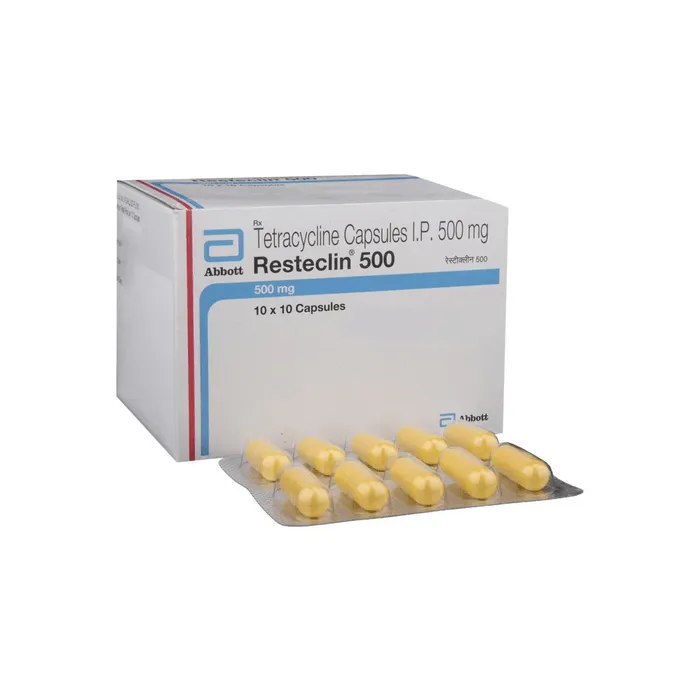
Resteclin 500mg (Tetracycline)
Previous product
Resteclin 250mg (Tetracycline)
A$13.00 A$21.66Price range: A$13.00 through A$21.66
Next product
Roxid 150mg (Roxithromycin)
A$34.66 A$83.75Price range: A$34.66 through A$83.75
A$17.33 A$24.55Price range: A$17.33 through A$24.55
In Stock
In Stock
Resteclin 500mg (Tetracycline)
| Pack Size | Price | Quantity | Add To Cart | |
|---|---|---|---|---|
| 60 Capsule/s | A$17.33 | |||
| 90 Capsule/s | A$20.22 | |||
| 120 Capsule/s | A$24.55 | |||
| Want to order in bulk / B2B price? Send Inquiry | ||||
×
Sorry!! Out of Stock
Sorry! Resteclin 500mg (Tetracycline) is out of stock
Please click below to view other similar medications.
View All Tetracycline Products
Offer You Can't Resist
Free Shipping
Enjoy Free Shipping on Orders above AUD304 (USD199)
Estimate Delivery :
16 September - 23 September
22
Highly Professional
Very professional company with a smooth ordering process. The staff were courteous and helpful, and the shipment was handled efficiently. I had a good overall experience.
 Australia
August 17, 2026
Last Updated on May 18, 2026

Description
Introduction
Resteclin is a trademark designation of Tetracycline, an antibiotic with a broad spectrum, which is employed to treat many types of bacterial-related illnesses. Tetracycline falls under the category of antibiotics referred to as Tetracyclines and is known as anti-bacteriostatic drugs that block the production of protein by bacteria. Resteclin 500mg is usually prescribed to treat infections that are due to vulnerable strains of gram-positive and gram-negative bacteria.
What is Tetracycline?
Tetracycline is a type of antibiotic that has been used in the clinical setting since the 1950s. It’s effective against an array of bacteria. It is commonly utilized when penicillins or other antibiotics are not recommended or are ineffective. It is used to treat urinary tract infections, respiratory tract infections, skin conditions, sexually transmitted illnesses, and other ailments.
Mechanism of Action
Tetracycline inhibits the synthesis of proteins by bacteria. It is a binding agent that binds in a reverse manner to the 30S ribosomal subunit of affected bacteria, preventing the attachment of aminoacyl-tRNA to the mRNA-ribosome compound. This blocks the addition of new amino acids into the expanding peptide chain, which stops the growth of bacterial cells (bacteriostatic result).
As it is not able to eliminate bacteria in a direct way, but hinders their growth, the host’s defense system has to be cleared of the disease.
Spectrum of Activity
Tetracycline has been proven to be effective against the majority of bacteria, which include:
- Gram-positive bacteria: Staphylococcus aureus, Streptococcus pneumoniae (some strains)
- Gram-negative bacteria: Haemophilus influenzae, Escherichia coli, Neisseria gonorrhoeae
- Atypical bacteria: Chlamydia trachomatis, Mycoplasma pneumoniae, Rickettsia species (typhus, Rocky Mountain spotted fever), and Borrelia burgdorferi (Lyme disease)
- Other organisms: Some protozoa and spirochetes
Pharmacokinetics
- Absorption: Tetracycline is absorbed quickly through the digestive tract, but it is absorbed in a manner that can be diminished by dairy products, antiacids as well as iron supplements.
- Distribution: It’s widely distributed throughout the body’s tissues and in fluids, such as the liver, bile, kidneys, and the skin.
- Metabolism: Minimal hepatic metabolism.
- Elimination: Mostly excreted unchanged from the feces and urine. The half-life ranges from 6 to 12 hours.
Clinical Uses
Resteclin 500mg (Tetracycline) is suggested for treating:
- Respiratory tract infections: The cause is bronchitis, and pneumonia is caused by bacteria that are susceptible to infection.
- Urinary tract infections
- Acne vulgaris: Tetracycline has proven effective in mild to severe acne.
- Sexually transmitted infections: Particularly, Chlamydia infections as well as Syphilis (in people who are penicillin allergic).
- Rickettsial infections: Rocky Mountain spotted fever, typhus.
- Lyme disease
- Cholera
- Anthrax
- Other infections: Like leptospirosis, brucellosis, and some protozoal diseases.
Dosage and Administration
- Adults: The usual dosage is 250 mg every 6 hours or 500 mg every 12 hours. Total daily doses range from 1 to 2 grams according to the type of infection.
- Duration: Vary from 7-14 days or longer, based on the severity and type of the illness.
- Administration: Taken on an empty stomach (1 hour before or 2 hours after eating) and accompanied by a glass of fluids. Beware of taking dairy products, antacids, or iron supplements at the same time since they can reduce absorption.
Side Effects
Although generally efficient, Tetracycline is generally effective; it can trigger several negative side effects:
Common Side Effects
- Gastrointestinal disturbances: nausea, vomiting, diarrhea, abdominal pain
- Photosensitivity: A greater risk of sunburn following exposure to sunlight
- Tooth discoloration: permanent yellow-gray-brown staining to teeth in youngsters under the age of 8 years
- Hypersensitivity reactions: rash, itching
Serious Side Effects
- Hepatotoxicity: It is rare; however, it can happen in high doses or IV therapy.
- Intracranial hypertension: rare, characterized by headache, blurred vision
- The stomach may be irritated or even ulcerated if tablets are consumed without enough fluids or before getting into bed
- Superinfection: long-term use can result in an increase in the number of organisms that are not susceptible to it, including the fungi
Precautions and Contraindications
- Children under 8 years: It is not recommended because of the possibility of permanent discoloration of teeth as well as impacts on the growth of bone.
- Pregnancy: Avoiding it is generally recommended, particularly in the third and second trimesters, because of the possibility of developing fetal teeth and bone anomalies.
- Liver impairment: Take care as the risk of liver toxicity rises.
- Renal impairment: Adjusting the dosage may be necessary.
- Allergic history: It is not recommended if you have a history of hypersensitivity to Tetracyclines.
- Do not expose yourself for too long to the sun because of the risk of photosensitivity.
Drug Interactions
- Antacids, calcium, magnesium, iron, and zinc supplements: Lower absorption of tetracycline.
- Oral contraceptives: Can reduce effectiveness. Other contraception methods should be considered.
- Penicillin: Use in conjunction with penicillin may decrease the efficacy of penicillin.
- Warfarin: Might increase anticoagulant effects. This requires surveillance.
- Retinoids: The combination of use could increase the risks of developing intracranial hypertension.
Monitoring
- Check for clinical responses to the therapy.
- Look for indicators of an infection that is superinfectious.
- Monitor liver function during prolonged use.
- Check for any signs of allergic or photosensitive reactions.
Patient Counseling Points
- Follow the exact dosage in the manner it is prescribed.
- Do not eat anything by drinking a glass of water. Avoid lying on the floor immediately following taking.
- Do not consume dairy products, antacids, or mineral supplements within 2 hours following the medicine.
- Wear sunscreen and wear protective clothing in the outdoors.
- Be aware of any strange symptoms, like severe headaches, eye changes, vision issues, and extreme skin rashes.
- Continue the entire program of treatment, regardless of whether symptoms get better.
Conclusion
Resteclin 500mg (Tetracycline) is an antibiotic with a broad spectrum that is effective against many bacteria. Its antibacteriostatic activity by blocking the synthesis of proteins makes it effective for the treatment of urinary, respiratory, or dermatological infections as well as sexually transmitted diseases. Be aware of dosage, possible side effects, and interactions to ensure the best treatment outcomes. Due to the negative impact it has on the bones and teeth, it is recommended to avoid alcohol during pregnancy except when absolutely required.
Related products






Recently Viewed
Reviews
There are no reviews yet.