Penile Injections for ED
Previous product
Trimix penile injection
$121.00 $569.00Price range: $121.00 through $569.00
Next product
Wormentel 888mg
$50.00 $125.00Price range: $50.00 through $125.00
$121.00 $569.00Price range: $121.00 through $569.00
Out of Stock
Out of Stock
Penile Injections for ED
| Pack Size | Price | Quantity | Add To Cart | |
|---|---|---|---|---|
| 1 Bottle | $121.00 | |||
| 2 Bottle/s | $237.00 | |||
| 3 Bottle/s | $350.00 | |||
| 5 bottle/s | $569.00 | |||
| Want to order in bulk / B2B price? Send Inquiry | ||||
Offer You Can't Resist
Free Shipping
Enjoy Free Shipping on Orders above AUD304 (USD199)
23
Excellent service overall
Smooth checkout, quick dispatch, and secure delivery. Excellent service overall
 Australia
October 1, 2026
Last Updated on July 25, 2026

Description
Erectile dysfunction (ED) is a common condition that affects millions of men worldwide. It occurs when a man has difficulty achieving or maintaining an erection firm enough for satisfactory sexual activity. While oral medications such as phosphodiesterase type 5 (PDE5) inhibitors are often the first line of treatment, they are not effective for everyone. For men who do not respond to oral medications or cannot take them due to medical conditions, penile injection therapy can be an effective alternative.
Penile injections involve administering medication directly into the side of the penis using a very fine needle. Although the idea may seem intimidating at first, many men find the injections relatively easy to perform after proper training from a healthcare provider. Penile injection therapy has been used for decades and has demonstrated high success rates in producing reliable erections suitable for sexual intercourse.
What Are Penile Injections for ED?
Penile injections, also known as intracavernosal injections, involve injecting medication into the corpora cavernosa, the two sponge-like chambers inside the penis responsible for erections. These medications relax the smooth muscles and widen blood vessels, allowing increased blood flow into the penis and resulting in an erection.
Unlike oral ED medications, penile injections work locally at the injection site and do not rely on the body’s natural erectile response. This makes them particularly useful for men with diabetes, nerve damage, spinal cord injuries, or those who have undergone prostate surgery.
How Penile Injections Work
The medications used in penile injections relax the smooth muscle tissue lining the penile arteries and erectile tissue. As the muscles relax, blood vessels expand and allow more blood to flow into the penis. The increased blood flow fills the erectile chambers, producing an erection.
Once sexual activity is complete, the medication gradually wears off, allowing blood to leave the penis and the erection to subside naturally.
Most injections begin working within 5 to 20 minutes and can provide an erection lasting approximately 30 to 90 minutes, depending on the medication, dose, and individual response.
Common Medications Used
Several medications may be used alone or in combination for penile injection therapy.
Alprostadil
Alprostadil is one of the most commonly prescribed injectable medications for ED. It works by relaxing blood vessels and increasing blood flow to the penis.
Bimix
Bimix combines two medications, usually papaverine and phentolamine, to improve erectile function.
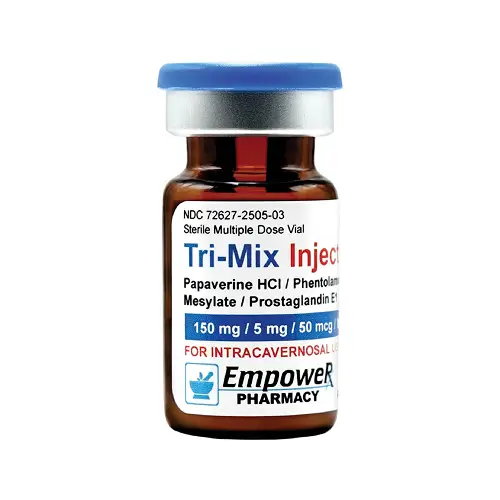
Trimix
Trimix is a combination of alprostadil, papaverine, and phentolamine. It is often prescribed for men who do not achieve satisfactory results with alprostadil alone.
The choice of medication depends on the individual’s medical history, treatment response, and healthcare provider’s recommendations.
Who May Benefit from Penile Injections?
Penile injection therapy may be recommended for men who:
- Do not respond adequately to oral ED medications
- Cannot take oral ED drugs because of medication interactions or medical conditions
- Have diabetes-related erectile dysfunction
- Experience ED following prostate surgery
- Have spinal cord injuries
- Have certain neurological conditions affecting erections
- Need a reliable treatment with a high success rate
A healthcare provider will determine whether injection therapy is appropriate after evaluating the underlying cause of erectile dysfunction.
How to Administer the Injection
Patients should receive detailed instruction from a qualified healthcare professional before attempting self-injection.
The general steps include:
- Wash your hands thoroughly.
- Prepare the prescribed medication and syringe.
- Clean the injection site with an alcohol swab.
- Inject into the side of the penile shaft, avoiding visible veins.
- Alternate injection sides with each use.
- Apply gentle pressure to the injection site for several minutes after removing the needle.
Patients should never exceed the prescribed dose or frequency of injections.
Benefits of Penile Injection Therapy
Penile injections offer several advantages for appropriate candidates.
- High success rate, even when oral medications fail
- Rapid onset of action
- Reliable and predictable erections
- Effective in many medical conditions causing ED
- Can improve confidence and sexual satisfaction
- May restore intimacy for couples affected by erectile dysfunction
Many studies report success rates exceeding 70% to 85% when patients are properly trained and monitored.
Possible Side Effects
Like any medical treatment, penile injections may cause side effects.
Common side effects include:
- Mild pain at the injection site
- Minor bruising
- Temporary redness
- Small amount of bleeding
Less common side effects include:
- Penile swelling
- Scar tissue formation with repeated injections
- Curvature of the penis due to fibrosis
- Mild dizziness
Most side effects are mild and improve with proper injection technique.
Serious Risks
Although uncommon, some complications require immediate medical attention.
Priapism
Priapism is an erection lasting longer than four hours. This is a medical emergency because prolonged erections can permanently damage erectile tissue if not treated promptly.
Severe Bleeding
Patients taking blood-thinning medications may have an increased risk of bleeding or bruising.
Infection
Using sterile technique significantly reduces the risk of infection.
Who Should Avoid Penile Injections?
Penile injection therapy may not be suitable for everyone.
It may be inappropriate for men with:
- Certain bleeding disorders
- Severe penile curvature
- Active penile infections
- Allergy to the prescribed medication
- Conditions associated with prolonged erections, such as sickle cell disease or certain blood disorders
A healthcare provider should evaluate each patient before treatment begins.
Precautions
Patients should always:
- Use only medications prescribed specifically for them.
- Never share needles or medication.
- Rotate injection sites to reduce the risk of scar tissue.
- Follow dosage instructions carefully.
- Store medications according to the manufacturer’s recommendations.
- Attend follow-up appointments for dose adjustments and monitoring.
Alcohol and recreational drug use may affect sexual performance and should be discussed with a healthcare provider.
Effectiveness
Penile injection therapy is among the most effective nonsurgical treatments for erectile dysfunction. Many men who do not benefit from oral medications achieve satisfactory erections with injections.
Treatment success depends on appropriate patient selection, correct injection technique, and individualized dose adjustment under medical supervision.
Lifestyle Measures to Support ED Treatment
Alongside medical treatment, healthy lifestyle habits can improve overall erectile function.
Helpful measures include:
- Maintaining a healthy weight
- Exercising regularly
- Controlling blood pressure and diabetes
- Quitting smoking
- Limiting alcohol intake
- Managing stress
- Getting adequate sleep
These changes may improve overall cardiovascular health, which plays an important role in erectile function.
Conclusion
Penile injections are a highly effective treatment option for erectile dysfunction, particularly for men who do not respond to oral medications or have medical conditions that limit other therapies. By delivering medication directly into the erectile tissue, these injections produce reliable erections with a rapid onset of action.
Although the treatment involves self-injection, most men become comfortable with the technique after proper instruction. As with any medical therapy, penile injections should only be used under the supervision of a qualified healthcare provider. Following the prescribed dosing schedule, using proper injection technique, and seeking prompt medical care for prolonged erections or other serious side effects are essential for safe and effective treatment.
Related products