
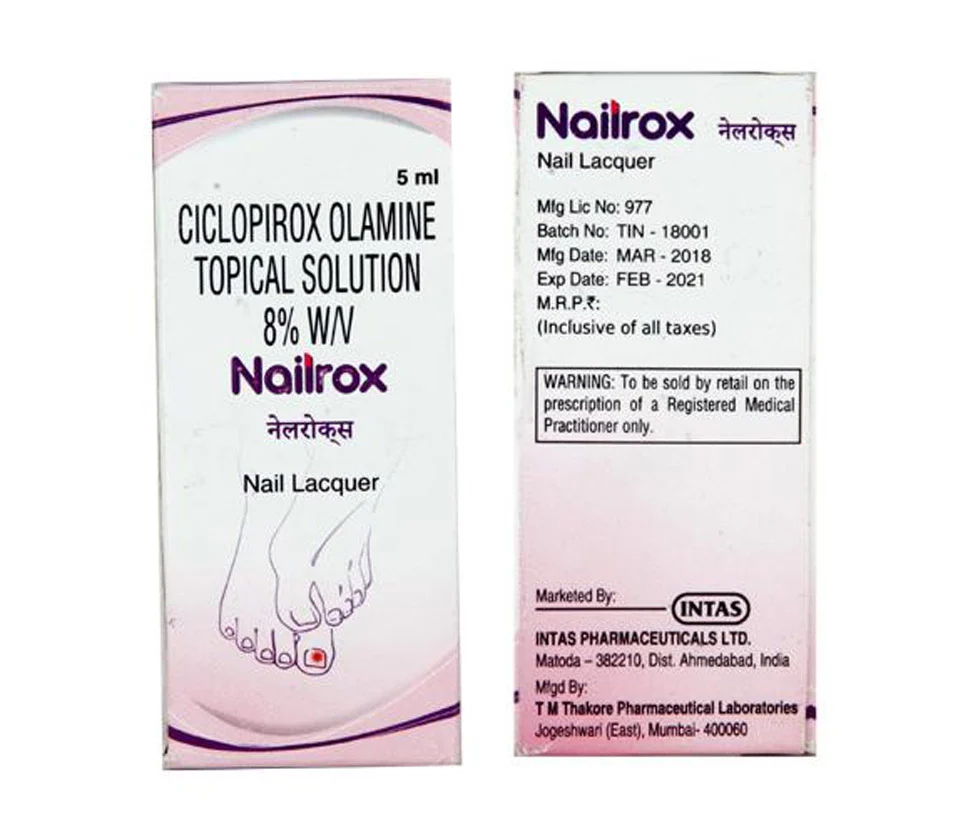
Nailrox Nail Lacquer 5ml (Ciclopirox)
Previous product

Neosporin 20g (Bacitracin/Neomycin/Polymyxin B)
$31.25 $106.25Price range: $31.25 through $106.25
Next product

Thyronorm 25mcg (Thyroxine Sodium)
$27.50 $95.00Price range: $27.50 through $95.00
$15.30 $65.63Price range: $15.30 through $65.63
In Stock
In Stock
Nailrox Nail Lacquer 5ml (Ciclopirox)
| Pack Size | Price | Quantity | Add To Cart | |
|---|---|---|---|---|
| 1 Bottle/s | $15.30 | |||
| 3 Bottle/s | $34.38 | |||
| 6 Bottle/s | $65.63 | |||
| Want to order in bulk / B2B price? Send Inquiry | ||||
×
Sorry!! Out of Stock
Sorry! Nailrox Nail Lacquer 5ml (Ciclopirox) is out of stock
Please click below to view other similar medications.
View All Ciclopirox Products

Offer You Can't Resist
Free Shipping
Enjoy Free Shipping on Orders above AUD304 (USD199)
Estimate Shipping :
20 June - 27 June
47
Professional service
Professional service from start to finish. Secure packaging, authentic products, and excellent customer care.
 Australia
May 28, 2026
Last Updated on April 28, 2026

Description
Introduction
Mupiheal Ointment is a topical antibiotic formulation that contains Mupirocin, widely used for treating bacterial skin infections. It is especially effective against common Gram-positive bacteria such as Staphylococcus aureus and Streptococcus pyogenes, including resistant strains like MRSA.
This medicine is designed for localized skin infections, meaning it works directly at the site of infection and minimizes systemic exposure. Because of its strong antibacterial action and good safety profile, Mupirocin ointments like Mupiheal are commonly prescribed in dermatology and general practice.
What is Mupirocin?
Mupirocin is a naturally derived antibiotic produced by Pseudomonas fluorescens. It belongs to a unique class of antibiotics that do not cross-react with other major antibiotic families, making it useful in resistant infections.
It is available as a cream or ointment and is used externally on the skin. It is not meant for internal infections such as respiratory or urinary infections.
Mechanism of Action (How It Works)
Mupirocin works by stopping bacterial protein synthesis, which is essential for bacterial survival and multiplication.
Isoleucyl-tRNA synthetase inhibition → protein synthesis blocked → bacterial growth stops → infection eliminated\text{Isoleucyl-tRNA synthetase inhibition → protein synthesis blocked → bacterial growth stops → infection eliminated}
By targeting the enzyme isoleucyl-tRNA synthetase, Mupirocin prevents bacteria from producing essential proteins. Without these proteins, bacteria cannot grow or repair themselves, leading to their eventual death.
Because of this targeted mechanism, Mupirocin is highly effective in localized infections and has minimal impact on the rest of the body when applied correctly.
Common Uses of Mupiheal Ointment
Mupiheal Ointment is prescribed for several bacterial skin conditions, including:
1. Impetigo
Impetigo
Impetigo is a common skin infection in children and adults. It causes red sores that rupture and form crusts. Mupirocin is considered a first-line treatment.
2. Folliculitis
This condition occurs when hair follicles become infected, leading to small red bumps or pus-filled lesions. Mupirocin helps reduce bacterial growth and inflammation.
3. Infected Wounds and Cuts
Minor cuts, abrasions, burns, or surgical wounds can become infected. Mupiheal prevents bacterial colonization and speeds healing.
4. Eczema with Secondary Infection
When eczema skin cracks and becomes infected, Mupirocin helps control bacterial overgrowth and reduces worsening inflammation.
5. MRSA Skin Infections
MRSA Skin Infection
Mupirocin is effective against MRSA in localized skin infections, making it an important antibiotic in resistant cases.
6. Nasal MRSA Carrier Treatment
In some cases, Mupirocin is used inside the nostrils to eliminate MRSA colonization and reduce infection spread in healthcare settings.
How to Use Mupiheal Ointment
Proper application is essential for effective treatment:
- Clean the affected area with mild soap and water
- Dry the skin completely
- Apply a thin layer of ointment
- Gently spread without rubbing aggressively
- Wash hands before and after application
- Avoid covering unless instructed by a doctor
It is usually applied 2–3 times daily depending on severity.
Dosage and Duration
The dosage depends on infection type:
- Mild infections: 2 times daily for 5–7 days
- Moderate infections: 2–3 times daily for 7–10 days
- MRSA or resistant infections: as prescribed by physician
It is important to complete the full course even if symptoms improve early, as stopping treatment too soon can lead to recurrence or resistance.
Benefits of Mupiheal Ointment
1. Fast-Acting Antibacterial Action
Mupirocin works quickly on localized infections, often showing improvement within a few days.
2. Effective Against Resistant Bacteria
It works even against resistant strains like MRSA, which are difficult to treat with regular antibiotics.
3. Localized Action
Since it is applied topically, it acts directly on the infection site with minimal systemic absorption.
4. Prevents Infection Spread
It helps stop minor infections from worsening or spreading to surrounding skin.
5. Safe for Short-Term Use
When used correctly, it has a strong safety profile with minimal side effects.
Side Effects of Mupiheal Ointment
Most side effects are mild and localized:
Common Side Effects
- Burning or stinging sensation
- Redness at application site
- Itching or irritation
- Dry or flaky skin
Rare Side Effects
- Allergic skin reaction
- Swelling or rash
- Contact dermatitis
Very Rare
- Secondary fungal infection due to prolonged use
If severe irritation or allergic reaction occurs, use should be stopped immediately.
Precautions and Warnings
- Do not use if allergic to Mupirocin
- Avoid contact with eyes, nose, and mouth
- Do not apply on large open wounds unless advised
- Not intended for long-term continuous use
- Use cautiously in pregnancy and breastfeeding (doctor supervision required)
- Avoid unnecessary use to prevent antibiotic resistance
Drug Interactions
Since Mupirocin is applied externally, systemic drug interactions are rare. However:
- Inform your doctor if using other topical antibiotics
- Avoid combining with strong skin irritants unless prescribed
- Do not mix with unapproved creams or antiseptics
Resistance Concerns
Overuse or incorrect use of topical antibiotics can lead to bacterial resistance. This means bacteria may stop responding to treatment. Always use Mupiheal exactly as prescribed and avoid self-medication.
Storage Instructions
- Store at room temperature
- Keep tube tightly closed
- Avoid direct sunlight and moisture
- Keep out of reach of children
When to See a Doctor
Consult a healthcare professional if:
- Infection does not improve in 3–5 days
- Symptoms worsen despite treatment
- Severe redness, swelling, or pus appears
- Recurrent skin infections occur
Conclusion
Mupiheal Ointment (Mupirocin) is a highly effective topical antibiotic used for treating a variety of bacterial skin infections such as impetigo, folliculitis, infected wounds, and MRSA-related skin conditions. Its targeted action, strong antibacterial effect, and low systemic absorption make it a trusted choice in dermatological care.
Related products




Recently Viewed


Reviews
There are no reviews yet.