
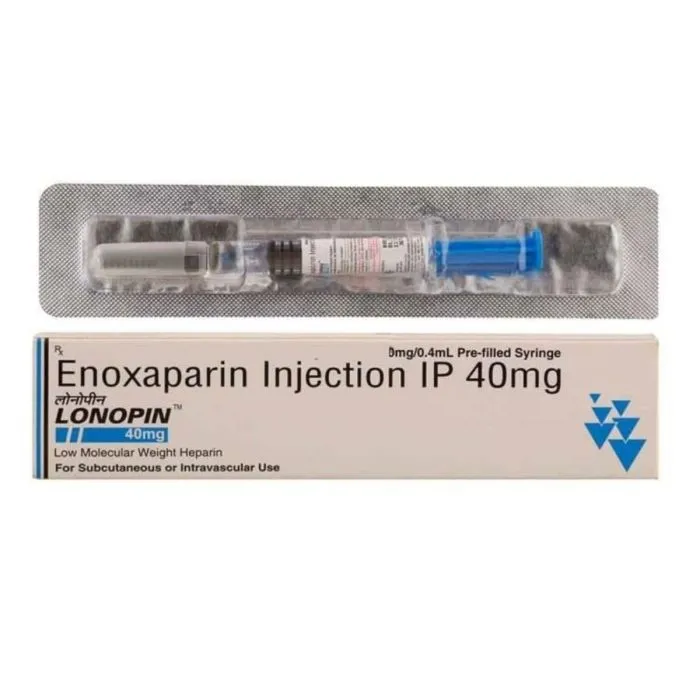
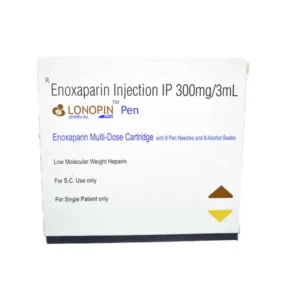
Lonopin 40mg Injection (Enoxaparin)
Previous product

Cefix O (Cefixime)
$81.00 $267.50Price range: $81.00 through $267.50
Next product
Lonopin 60mg Injection (Enoxaparin)
$82.00 $280.00Price range: $82.00 through $280.00
$65.00 $210.00Price range: $65.00 through $210.00
In Stock
In Stock
Lonopin 40mg Injection (Enoxaparin)
| Pack Size | Price | Quantity | Add To Cart | |
|---|---|---|---|---|
| 3 prefilled syringe/s | $65.00 | |||
| 6 prefilled syringe/s | $115.00 | |||
| 12 prefilled syringe/s | $210.00 | |||
| Want to order in bulk / B2B price? Send Inquiry | ||||
×
Sorry!! Out of Stock
Sorry! Lonopin 40mg Injection (Enoxaparin) is out of stock
Please click below to view other similar medications.
View All Enoxaparin Products

Offer You Can't Resist
Free Shipping
Enjoy Free Shipping on Orders above AUD304 (USD199)
Estimate Delivery :
25 October - 01 November
37
It’s my first time to Order this
I have been using ARTVIGIL 150 MG for the past few months, and I can confidently say that it has been a life-changing experience.
 Australia
November 29, 2024
Response from Modalertaustralia
Thank you for sharing your experience! We’re glad to hear ARTVIGIL 150 MG has made a positive difference for you. Your feedback means a lot to us and other customers. Please continue using the medication as directed and consult a healthcare professional if needed.
Last Updated on April 19, 2026

Description
What You Need to Know About This Blood Thinner
The clotting of blood, although sometimes life-saving, can also be hazardous and can cause medical complications such as deep vein thrombosis (DVT) and pulmonary embolism (PE), as well as strokes. In order to prevent and treat such conditions, medical professionals frequently prescribe anticoagulant medication. A popular medication includes Lonopin 40mg injection. Its main ingredient is Enoxaparin.
In this blog, that is comprehensive, we’ll discuss the nature of Lonopin injection and how it functions, when to use it in the correct way, how to administer it, possible side consequences, as well as safety measures.
What is Lonopin 40mg Injection?
Lonopin 40mg Injection has Enoxaparin Sodium, which is a heparin of low molecular weight (LMWH). It’s an anticoagulant that is commonly referred to as a blood thinner, which helps to prevent the development of dangerous blood clots within the blood vessels.
Contrary to conventional heparin that was used in the past, Enoxaparin provides an anticoagulant action that is more reliable and is administered by subcutaneous injection without regular checking.
How Does Enoxaparin (Lonopin) Work?
Enoxaparin enhances the effectiveness of antithrombin III and natural blood coagulation inhibitor. Components, particularly factor Xa, as well as to a lesser degree Factor IIa (thrombin).
- The inhibition can slow down the process of blood clotting.
- This reduces the chance of developing clots in the veins or the arteries.
- It aids in breaking down existing clots and stops their growth.
This is crucial when blood clots could hinder blood flow, leading to dangerous issues.
Uses of Lonopin 40mg Injection
Lonopin injection is used to treat many medical conditions. These include:
- Prevention of Deep Vein Thrombosis (DVT)
Most commonly, it is used by patients going through operations (especially orthopaedic procedures such as knee or hip replacement) or for those who have to be in beds to lower the chance of DVT.
- Treatment of Deep Vein Thrombosis and Pulmonary Embolism
Treatment for active blood clots as well as to prevent the development of new ones.
- Acute Coronary Syndrome (ACS)
In patients who suffer from unstable angina, heart attacks, or Enoxaparin helps prevent clot-related issues.
- Prevention of Clotting in Dialysis
In hemodialysis, it is used to stop bleeding from the dialysis circuit.
How is Lonopin 40mg Injection Administered?
- Route: Injections subcutaneous (under the skin)
- Common Sites: Abdomen (fatty region around the belly), either in the thigh or the upper arm
- Frequency: Most often, it is once or twice a day according to the health condition and the doctor’s recommendations
- Dose: A 40 mg dose is typically utilized as a prophylaxis (prevention), and larger doses can be utilized as active treatments.
Proper Injection Technique:
- Cleanse your hands thoroughly.
- The injection area should be cleaned with an alcohol wipe.
- Make a fist-like impression on the skin. An opening.
- Place the needle at an angle of 90 degrees.
- Take the medication in a slow and steady manner.
- Get rid of the needle and dispose of it safely.
- Don’t rub on the site of injection in order to avoid bruises.
Precautions and Contraindications
Before using Lonopin Injection, notify your doctor that you:
- Are you a victim of a bleeding disorder
- Are you taking blood thinners, anticoagulants, or other blood-thinning medications
- Have kidney problems
- Are pregnant or breastfeeding
- Do you have an allergy to heparin or pork products
- Recently had surgery or an injury that has a risk of bleeding
Possible Side Effects
Common Side Effects:
- Pain, bruising, or redness at the injection site
- Minor bleeding, such as gum bleeding, nosebleeds
Serious Side Effects (Require Immediate Medical Attention):
- Unusual or severe bleeding (blood in urine/stool, prolonged bleeding)
- Signs of allergic reaction (rash, itching, swelling, difficulty breathing)
- Heparin-induced blood clots (HIT) is A rare disorder that results in an increase in platelets as well as an increased risk of clot formation
Monitoring During Treatment
Contrary to the traditional heparin formula, Enoxaparin generally needs more frequent tests for blood. But, in certain instances in particular, such as kidney problems or use for a long time the doctor might check:
- Platelet counts
- Kidney function tests
- Signs of bleeding
Drug Interactions
Tell your physician about any medicines and supplements that you’re using, including:
- Other anticoagulants (warfarin, aspirin, clopidogrel)
- Nonsteroidal anti-inflammatory drugs (NSAIDs)
- Certain herbs (like garlic, ginkgo, or ginger) are known to increase bleeding risks
Tips for Safe Use
- Do not share needles or Syringes.
- The medication should be stored according to directions, typically kept in a dry, cool area.
- Make sure to attend all medical appointments scheduled for follow-up.
- Tell your healthcare professional (dentist or surgeon) of the fact that you’re taking Lonopin to prevent complications from surgical procedures.
Frequently Asked Questions (FAQs)
Can I self-administer Lonopin Injection at home?
Yes, indeed, a lot of patients learn how to administer their own medication at home after receiving proper instruction from healthcare professionals.
What should I do if I miss a dose?
You should take it as soon as you remember. But when it’s close to the next dose scheduled, you can skip your missed dose. Make sure you don’t increase the dosage.
Can I use Lonopin Injection if I have kidney problems?
Adjustments to your dosage may be required. Make sure you inform your physician of the condition of your kidneys.
Is it safe during pregnancy?
Enoxaparin is usually regarded as less risky than anticoagulants that are used during pregnancy; it must be administered only with medical supervision.
How long will I need to be on this medication?
The duration of treatment is dependent on the disease the patient is treating. Certain patients may need short-term treatment following surgery. Others may require longer-term care.
Conclusion
Lonopin 40mg Injection (Enoxaparin) is a crucial medication used for the purpose of the treatment and prevention of blood clots. It saves lives by decreasing the chance of complications resulting from thrombosis. The predictable effects, the ease to administer, and a more secure profile when compared with traditional heparin are reasons why it is a popular treatment option for a wide range of situations.
Use Lonopin with the advice of your physician, adhere to directions carefully, and be sure to make sure you follow up for a you are receiving a safe and efficient treatment.
Disclaimer: This blog is meant for informational purposes only. It does not substitute for medical advice from a professional. Always consult with your doctor prior to introducing or discontinuing any medicine.
Related products



Reviews
There are no reviews yet.