
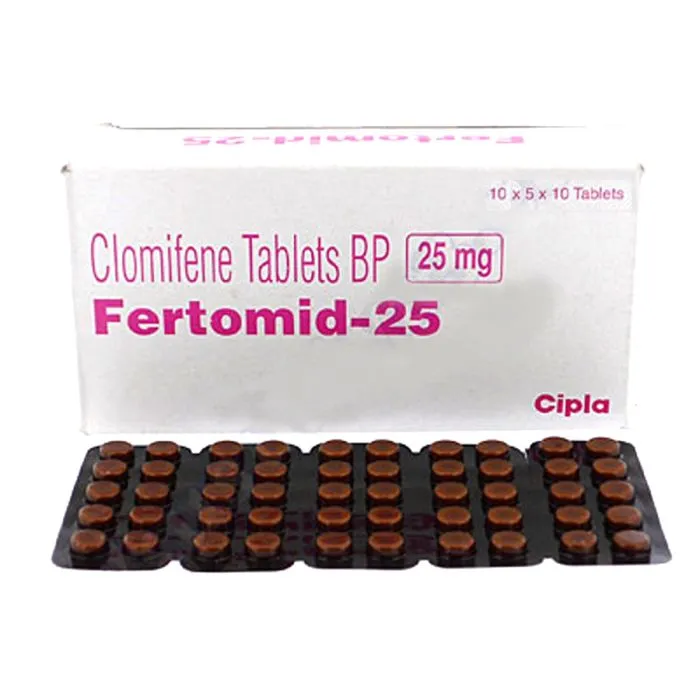
Fertomid 25mg (Clomiphene)
Previous product
Duvadilan Retards 40mg (Isoxsuprine Hcl)
$25.00 $45.00Price range: $25.00 through $45.00
Next product
Proluton Depot 500mg Injection (Hydroxyprogesterone Caproate)
$31.25 $117.50Price range: $31.25 through $117.50
$24.86 $40.40Price range: $24.86 through $40.40
Out of Stock
Out of Stock
Fertomid 25mg (Clomiphene)
| Pack Size | Price | Quantity | Add To Cart | |
|---|---|---|---|---|
| 60 Tablet/s | $24.86 | |||
| 90 Tablet/s | $32.63 | |||
| 120 Tablet/s | $40.40 | |||
| Want to order in bulk / B2B price? Send Inquiry | ||||
×
Sorry!! Out of Stock
Sorry! Fertomid 25mg (Clomiphene) is out of stock
Please click below to view other similar medications.
View All Clomiphene Products

Offer You Can't Resist
Free Shipping
Enjoy Free Shipping on Orders above AUD304 (USD199)
31
happily order again
Fast, convenient, and professional service. I would happily order again
 Australia
September 27, 2026
Last Updated on March 21, 2026

Description
Introduction
Infertility impacts thousands of couples around the world. The most prevalent causes among females are the ovulation disorder. If the ovaries don’t shed eggs frequently, the process of conception is difficult. Medical science can provide numerous treatments to enhance ovulation. Clomiphene citrate is among the most commonly used.
Fertomid 25 mg is a trademark term for Clomiphene Citrate, a medication designed to increase ovulation levels among women who struggle with conceiving due to irregular or absent Ovulation. This blog explains the nature of Fertomid, how it operates and when, and the most important safety issues.
What is Fertomid 25 mg?
Fertomid contains Clomiphene Citrate, a selective estrogen receptor modulator (SERM). It’s an oral medicine used to induce Ovulation. Clomiphene has been used since the 1960s and continues to be an initial treatment for female infertility triggered by anovulation or oligo-ovulation.
The tablet you take of Fertomid contains 25 mg of Clomiphene Citrate.
How Does Fertomid Work?
Fertomid tricks the brain into believing that the levels of estrogen in your body are not high. Normally, estrogen released from the ovaries signals the pituitary gland and hypothalamus to regulate hormone production, for example, Follicle-Stimulating Hormone (FSH) and Luteinizing Hormone (LH).
When Clomiphene blocks estrogen receptors in the hypothalamus, it prevents this feedback, leading the brain to release more GnRH (gonadotropin-releasing hormone). It, in turn, increases the pituitary gland’s ability to release greater levels of FSH as well as LH. The increased FSH increases the size of follicles in the ovarian gland, possibly stimulating ovulation.
Who Should Use Fertomid?
Fertomid is usually prescribed for women who:
- Have irregular or absent ovulation (anovulation/oligo-ovulation)
- Have polycystic ovary syndrome (PCOS)
- Are experiencing infertility without explanation, but are concerned about Ovulation issues
- You want to induce ovulation, one of the assisted reproductive methods, such as intrauterine insemination (IUI)
How is Fertomid Used?
- Dose: The recommended starting dose is typically 50 mg daily (2 tablets of 25mg), taken orally for five consecutive days during the early menstrual cycle. Typically, it starts at day 3, 4, or 5.
- The doctor can adjust the dosage for subsequent cycles, based on your responses.
- The ovulation period usually lasts between 5 to 10 days following the completion of treatment.
- Your physician may be able to monitor the growth of your follicles using ultrasound or hormonal blood tests.
What Are the Benefits of Fertomid?
- Induces ovulation for women who don’t often ovulate
- Low-cost and non-invasive when compared with injectable fertility medications
- Oral administration is easy and can to done at home
- Has helped millions of females across the globe to conceive with success
Possible Side Effects
Similar to all drugs, Fertomid can cause side effects. Most are minor and short-lived; however, it is important to discuss the issue with your physician.
Common side effects include:
- Hot flashes
- Mood swings or irritability
- Headaches
- Nausea or stomach discomfort
- Breast tenderness
- Visual disturbances (rare but important to report)
- Ovarian enlargement (usually temporary)
Less common risks:
- Numerous pregnancies (twins or many) increase the risk of having a baby.
- Ovarian hyperstimulation syndrome (OHSS) is an extremely rare but potentially dangerous disorder
Precautions and Contraindications
- Fertomid is not recommended for women who are pregnant or who suffer from thyroid problems that are not controlled or adrenal issues.
- This medication is not recommended for women suffering from liver disease or vaginal bleeding that has no known cause.
- Females with cysts of the ovary that aren’t connected to PCOS need to be assessed with care.
- Tell your physician about any other medication you use.
What to Expect During Treatment
- Your doctor will generally monitor you through ultrasound scans, which are used to assess the growth of your hair follicles.
- Blood tests can be used to determine hormone levels.
- If there is a recurrence of ovulation, the timed intercourses or inseminations will be recommended.
- If you don’t see results from Fertomid after a few cycles, your physician may suggest other options.
FAQ About Fertomid (Clomiphene Citrate)
How long does Fertomid take to work?
Ovulation usually occurs between 5 and 10 days after the five-day program. It can take several cycles to become pregnant.
Can Fertomid cause multiple pregnancies?
Yes, in fact, 5-10% of births after Clomiphene use involve twins or higher-order multiples.
Is Fertomid safe during pregnancy?
No, Fertomid is not used to stimulate ovulation before pregnancy. It is best to stop it when pregnancy is confirmed.
What if Fertomid doesn’t cause ovulation?
Your physician may recommend increasing the dosage or even consider alternative fertility treatment.
Can men use Clomiphene?
Clomiphene can be used without a prescription by men to improve the quality of sperm, but it is done under medical supervision.
Should I take Fertomid with food?
It is acceptable to take it with or without food; follow your physician’s instructions.
Conclusion
Fertomid 25 mg (Clomiphene Citrate) remains an important treatment for women who struggle with infertility related to ovulation. If properly monitored by a doctor, the drug is a safe and efficient method to increase fertility and increase the likelihood of having a child.
If you believe Fertomid might be the right choice for you, consult your doctor for an in-depth analysis and customized treatment plans.
Related products








Reviews
There are no reviews yet.